Introduction.
Design systems changed how we build interfaces.
The concept took shape in the early 2010s as engineering and design teams at large organizations, such as Google, IBM, Salesforce, and Airbnb, started asking a common question: why does every new product have to reinvent the same buttons, headers, forms, and navigation patterns from scratch? The answer was to stop treating UI elements as one-off decisions and start treating them as a governed, reusable library. A design system defines the components of an interface: their visual properties, their behavior, their approved usage, and makes them available across teams. Build the button once. Govern it once. Use it everywhere.
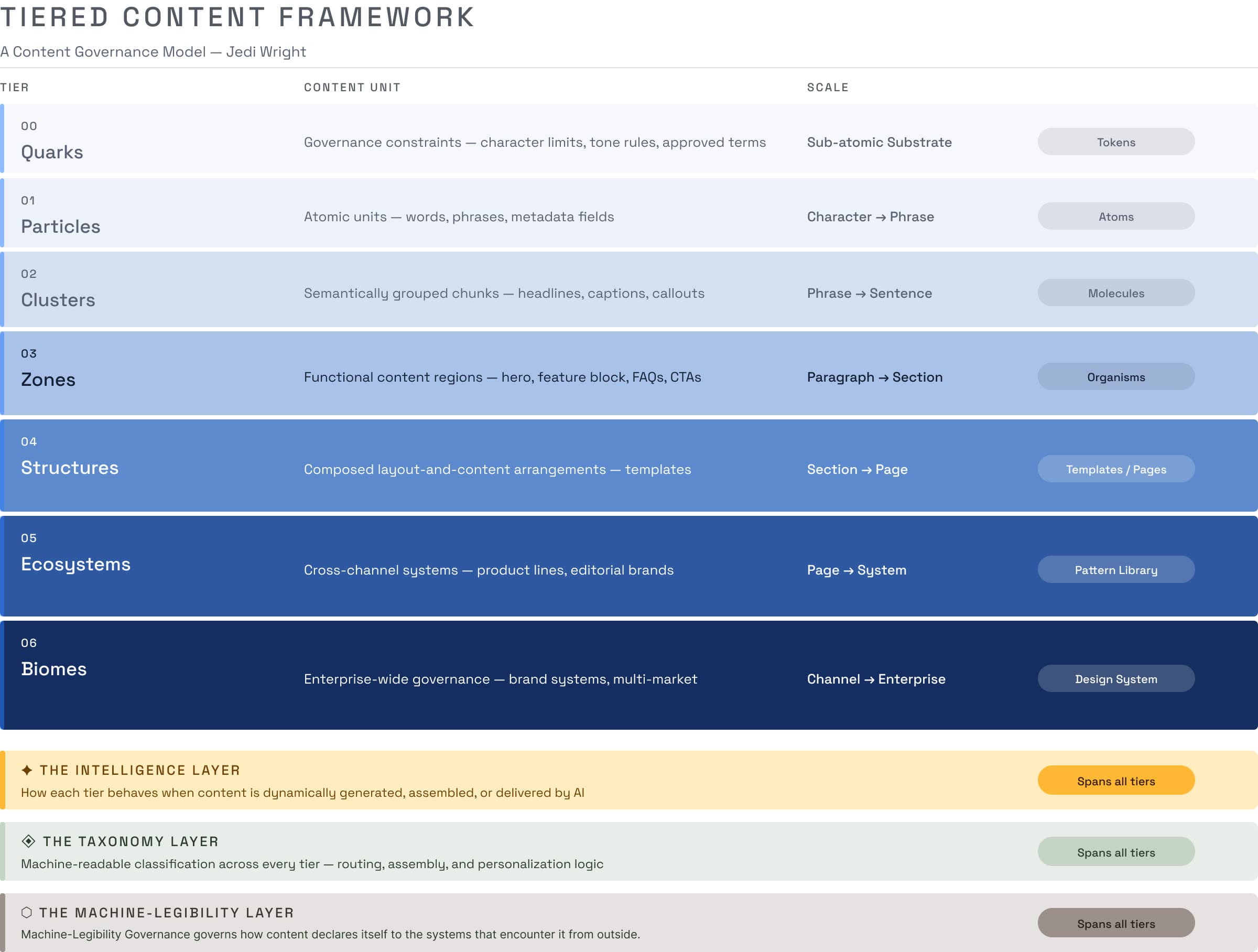
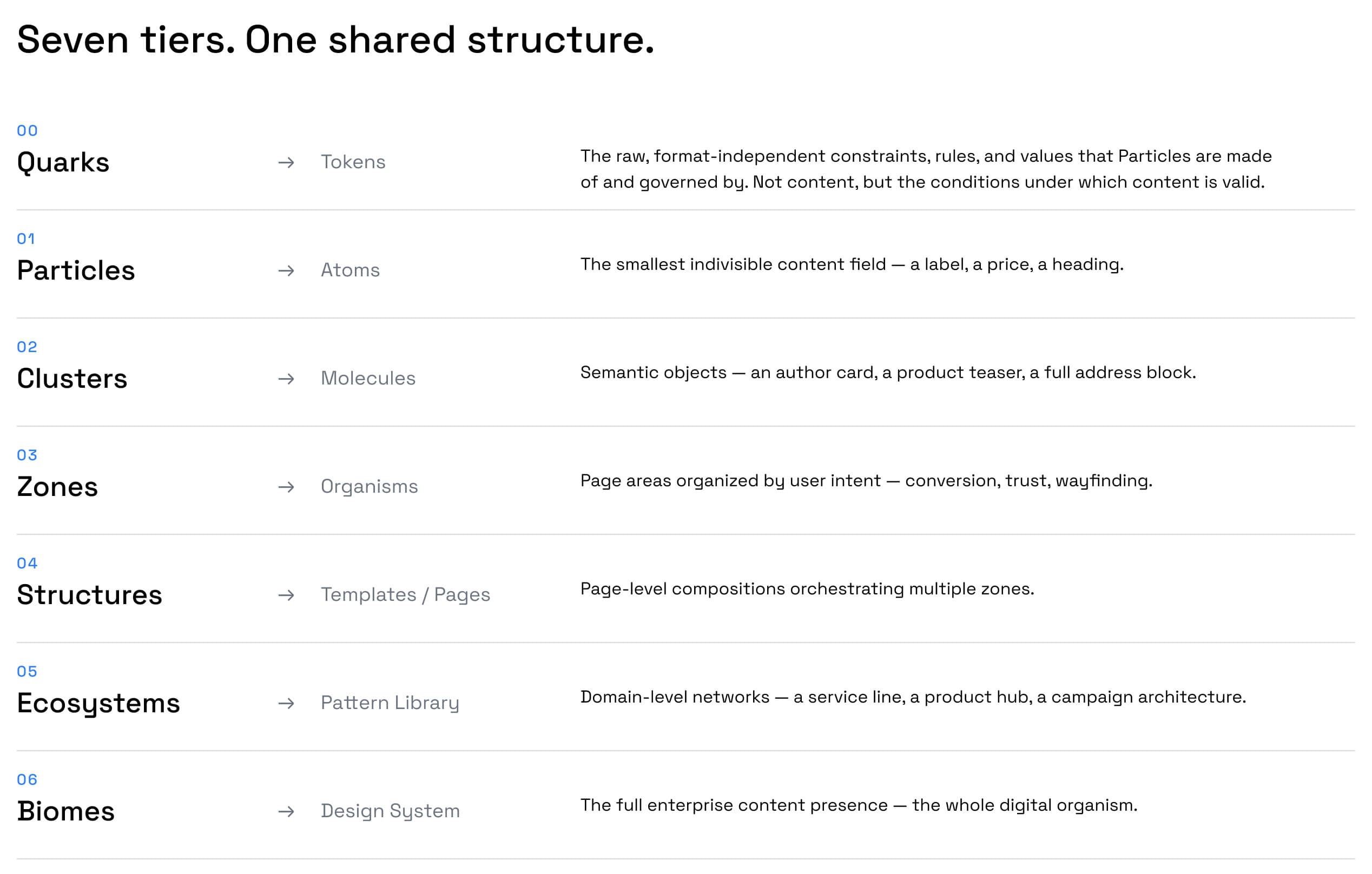
TheAtomic Design methodology, introduced by Brad Frost in 2013, gave that approach a principled structure. Frost argued that interfaces could be decomposed into a hierarchy of reusable parts: atoms (a single UI element like a label or an input field), molecules (small groups of atoms that function together), organisms (larger interface sections composed of molecules), templates (page-level arrangements) and pages (the final rendered instances). The framework gave design and engineering teams a shared vocabulary and a compositional logic that made UI components governable at scale. It became one of the defining moves of the modern digital product era.
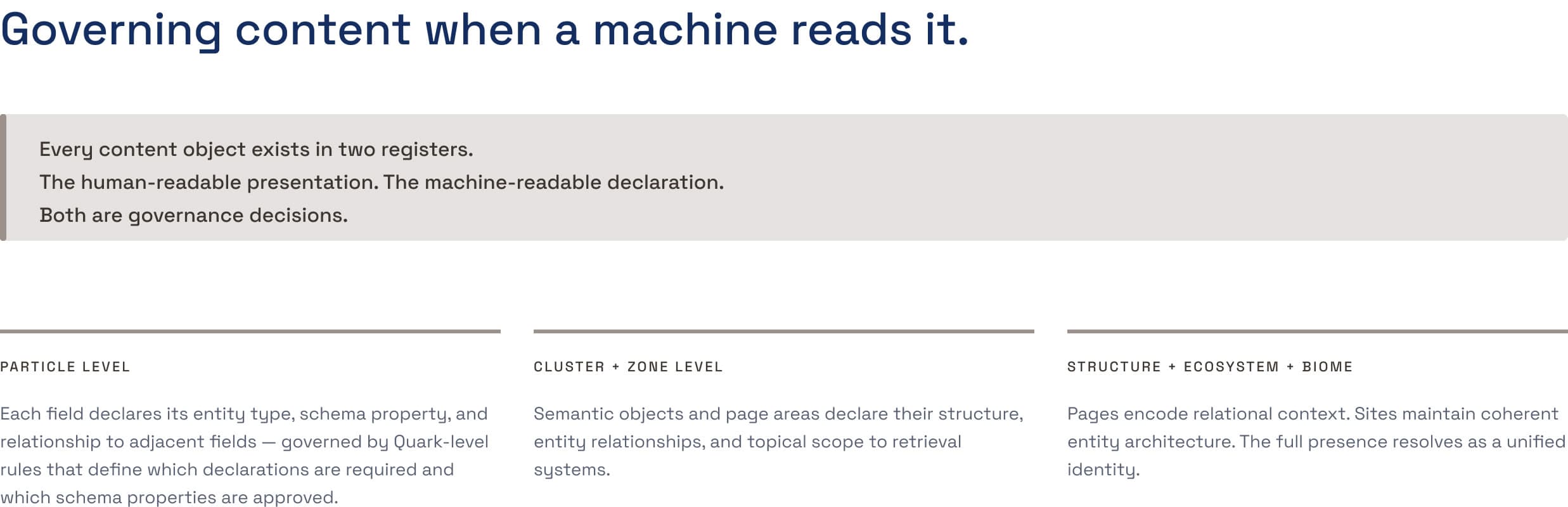
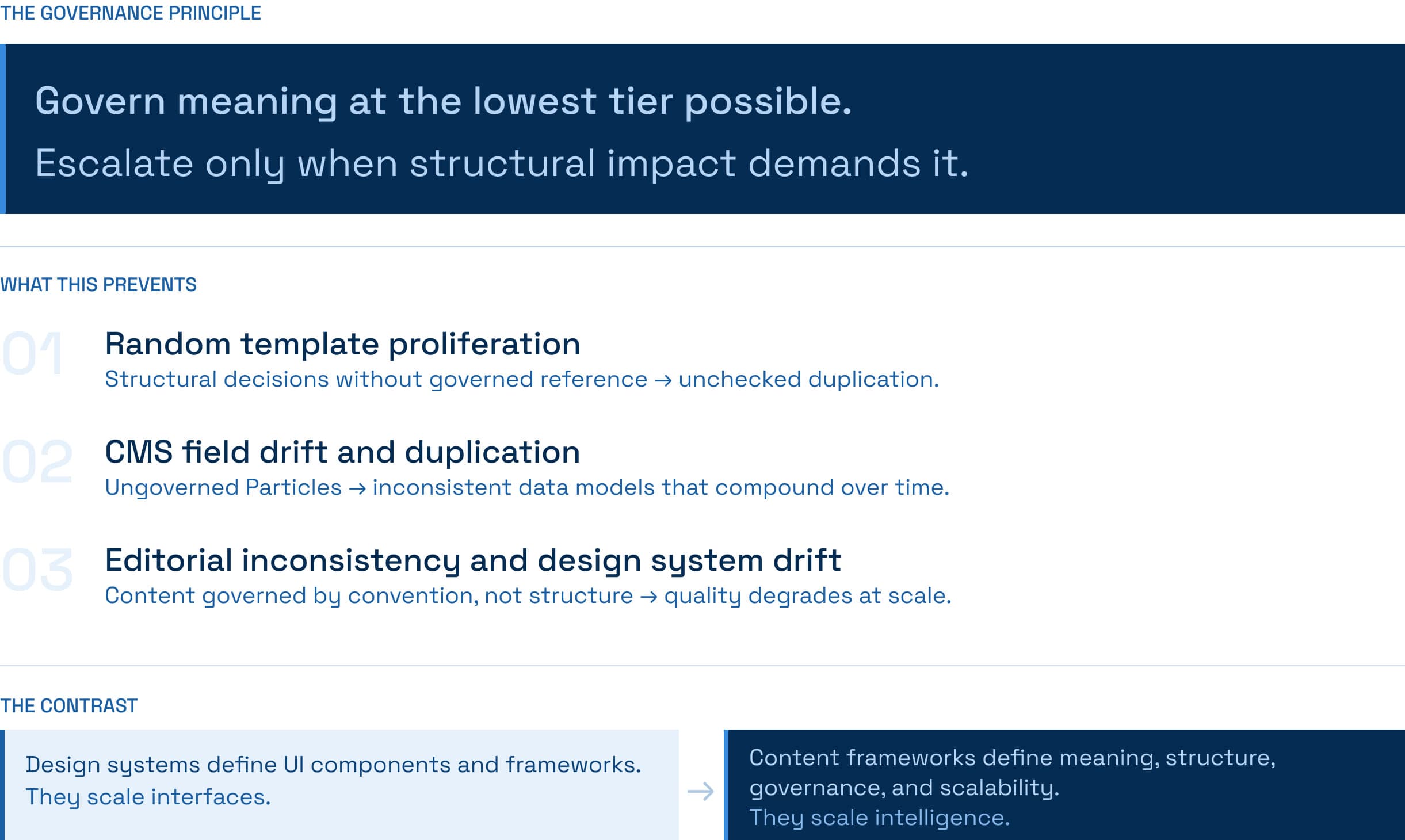
But there’s a gap no one fully accounted for: the content living inside those components remained ungoverned.
In practice, this gap looks like this: a product team carefully governs their card component, the container, the image dimensions, the type styles or the spacing, but the headline that goes inside it gets written differently by every author who touches it. One team writes it as a noun phrase, while another writes it as a sentence; a third uses it to surface a promotional message it was never designed to hold. The component is consistent. The content inside it, isn’t. Multiply that across hundreds of components, dozens of authors and several years of CMS drift, and you get experiences that look coherent at the interface layer and fragment at every layer beneath it.
Voice and tone guides tell you how the content should sound. Editorial checklists tell you when it’s ready to publish. But neither instrument addresses how content should be structured, modeled, related to other content, governed at the field level or reused across an enterprise digital ecosystem. The result is a predictable failure mode: experiences that look coherent at the interface layer and fragment everywhere else. Inconsistent messaging. CMS architectures are built on drift and duplication. Authoring workflows that depend on individual expertise rather than shared system logic. And every replatform, every personalization initiative, every channel expansion that grinds to a halt at the content layer.