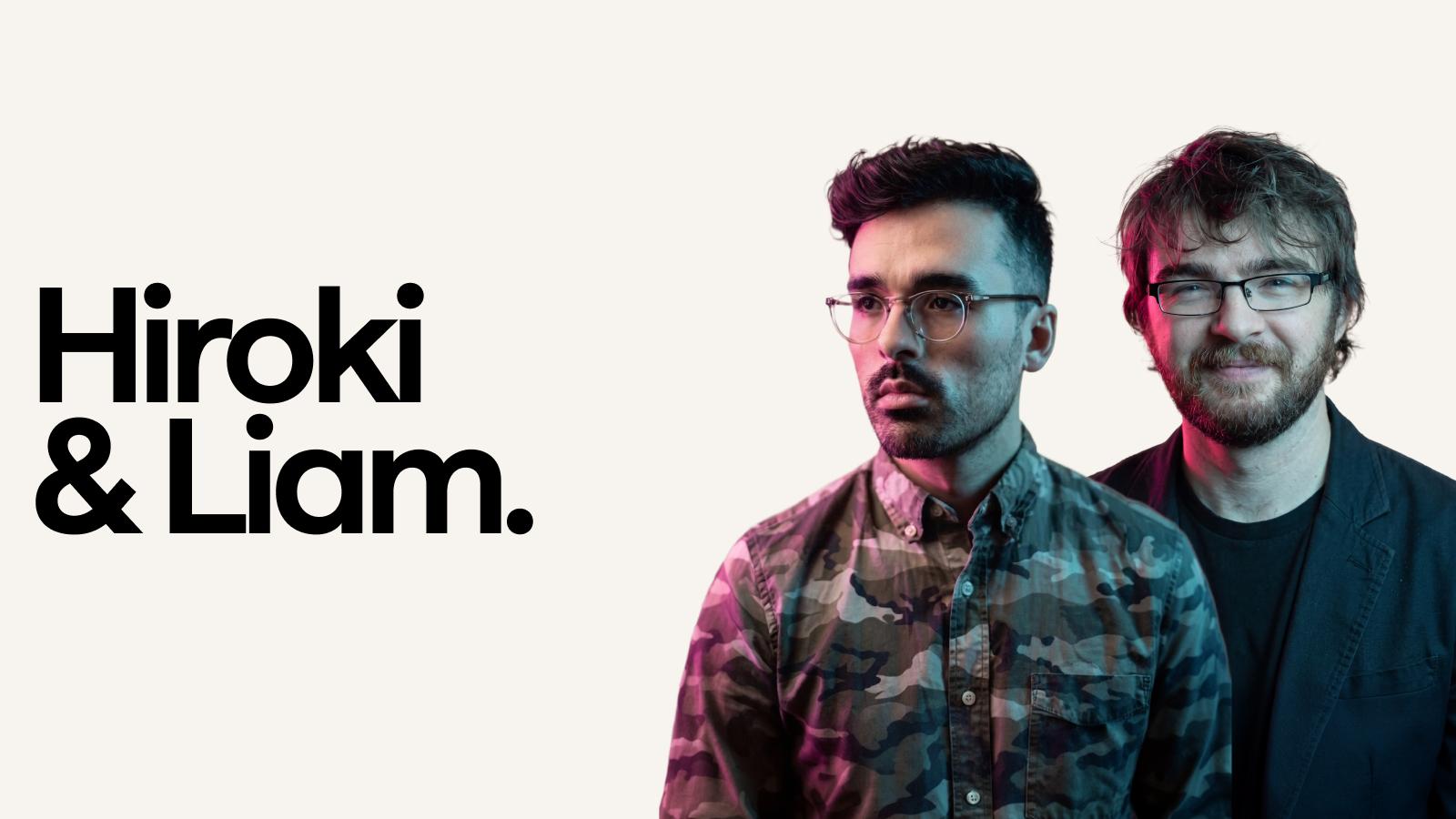
Makers #12: Hiroki Murakami and Liam Grant. | Huge
Makers #12: Hiroki Murakami and Liam Grant.
When data and strategy align, the judgment that follows is what turns it into something useful.
Makers
November 9, 2026
Jessica Strubel, Senior Marketing Manager
Intro.
For Hiroki Murakami and Liam Grant, it all begins with trust in each other’s expertise. That, and a shared passion for gaming that shapes the marketing campaigns they’ve delivered for a global gaming company. Liam sets the data foundation, Hiroki steers the direction.
Their mutual trust has built a common language around outcomes rather than methods. Neither sees hard limits on where their skills meet and overlap—the question is never how the data works, it's what it’s telling them. A gaming campaign works differently to a standard advertising campaign. It’s not just clicks based on media spend. Rather, it’s a dynamic and unpredictable engagement, closer to a conversation than a product launch.
As Senior Director of Strategy, Hiroki oversees the process by keeping an eye on the bigger picture: understanding gamers, the gaming landscape and how to make advertising that resonates. Liam, in turn, provides the data the teams need to make decisions and a concrete understanding of the wider landscape around topics and brands.
The brief is the beginning.
Hiroki: What’s really unique about this account—and something I think we both benefit from enormously—is that it’s a large retainer. We meet our deadlines, we deliver what’s expected, but we’re also able to reinvest a lot of our time into what I’d almost call R&D.
Anything that deepens our understanding of the gaming ecosystem makes the work better. There’s an almost infinite correlation between how well you understand this space and the quality of your recommendations—because gaming is a category where deep subject matter expertise is non-negotiable. It’s not like any other category. If you know it, you can win it.
So we often have the luxury of writing our own briefs. There’s a bit of time between projects and we’ll use it to go and explore—who are the YouTube creators in this space, what kind of content do they make, how would we engage with them? There’s no hard mandate or deadline. It’s just: we have a window, let’s use it to understand something better, because it’s going to make the next piece of work stronger.
Liam: Some of our video game titles are recurring and come out every year, the brief from the client is essentially the same each time. But the depth we bring to it keeps growing. We deliver, they’re happy, and then it becomes: what else can you add? How deep can you go? Can you add a competitor set? Can you look at how these things are received over time? Getting to that level is genuinely interesting for the clients.
Get Huge in your DMs.
Sign up for the latest thinking, work, and news—straight to your inbox.
And because of the retainer, there’s sometimes space to build our understanding of the wider space. I remember one question that came up—I think it started internally to support a piece of work—around whether the art style on a game’s cover needed to match the art style of the actual game. It sounds like a simple question but it’s actually a really interesting one to dig into. Those kinds of questions tend to spawn from having the time and the curiosity to go looking.
Hiroki: One thing worth saying out loud, and it explains a lot of why we do what we do, is that gamers are very online. The gap between what people say online about toothpaste and what they actually think about toothpaste is enormous. But with gaming, what people say online and what they actually think and feel is incredibly intertwined. That’s why we place so much emphasis on understanding how people are talking about things online because in this space, it genuinely reflects how they feel.
Liam: The scale of data available for gaming compared to other clients is on a completely different level. We’re talking anywhere from a thousand to ten thousand times more data points than on most asks. At the higher end we’re getting close to five to six billion verbatims (individual comments, posts and reactions from real people talking about games online) and, tied to each verbatim, there are multiple additional data points. This gaming company is without doubt our biggest client in terms of how much data they consume and how often they consume it.
And that’s not a one-off. Every single title generates that volume. Some clients we work with barely get ten thousand responses. Hiroki and the wider strategy team have done a really strong job of defining what the process looks like at that scale.
Data behind the decisions.
Liam: When you start pulling in competitor data alongside your own, that’s where the white space emerges, you can start defining what actually matters and building baselines. And as long as that process stays consistent, you have a comparable data set that lets you track how things evolve over time.
One of the biggest things with this global gaming company is that, because of the sheer scale of data, we’ve built out processes on the data science side that are essentially built just for them. They can be applied elsewhere, but without them we’d be spending hundreds of millions on compute. That’s really where the investment in the process pays off.
Hiroki: And to give your team credit, there’s a huge amount of rigour built into the process on the data side. Data quality, fact-checking large language models, training across multiple languages at a high degree of accuracy. That foundation matters enormously.
For me, what’s always been critical, and it’s where we focus so much energy, is combining that with subject matter expertise and real perspective. Making sure we don’t lose the forest for the trees. Because there’s a lot of noise out there, and you really have to know whether something is noise or signal.
Should we be concerned about this, or does it just look alarming on the surface? How does it compare to what we’ve seen historically, what we’ve seen with competitors, what we’ve seen across the wider space? That judgment is what turns data into something useful.
The work.
Liam: For some of our work, we used Intelligent Twin—a tool that creates synthetic replicas of real audience segments—to replicate audiences and their reactions and emotions when watching trailers. It allowed us to synthetically look at the high and low points, understanding when different types of gamers would connect with moments in the trailer and when things weren’t quite landing. We were also able to use those audience twins to pitch a range of different marketing ideas, which was really fun. It was great to work with the team on that. It was one of those projects where we had a really good back and forth, with a few sessions together to get their perspective and make sure we were aligned.
Hiroki: That’s definitely one of the more advanced and sophisticated projects we’ve worked on together. What’s interesting is how much our roles have evolved, the way we work now, we’re almost like product managers. We’re talking about products, building products, building data tools that strategists simply wouldn’t have been doing five years ago. To have an actual product, something tangible we’re building together that delivers real value, that you can iterate on and keep improving—that’s genuinely exciting.
My example is a bit more rooted in the day-to-day work we do together. I’ve found it fascinating to take a completed marketing campaign from the gaming space, pull in everything—every piece of content, every conversation—and look at it end to end. What makes it interesting is that a gaming campaign doesn’t behave like a standard advertising campaign. It’s not just clicks going up or down based on media spend. It’s much more dynamic, almost like a conversation. The opinion cycle rises and falls. Someone says something, a trailer drops, a thread starts, a meme takes off. Being able to look at all of that end to end and understand how those things actually function has been genuinely fascinating.
You do the math.
Hiroki: You definitely don’t want me doing Liam’s kind of math. I’d break something! That’s a pretty clear line.
Liam: Hiroki keeps the cart on track. He’s great at defining the brief, at knowing exactly what data we need and what we don’t, which sounds simple but makes an enormous difference. Being able to read a brief and immediately know how to approach it is a real skill, especially when we’re working across such different time zones. And I know he brings a depth of knowledge that keeps me on my toes, sometimes he’ll drop a strategic term and I’ll find myself googling it. But that’s what makes it work. Data science is in such an interesting place right now, especially in the context of AI.
Anyone can go and get something that looks pretty good. But grounding it in real data, machine learning principles and solid traditional strategic thinking, that’s where the foundation matters. You need that knowledge on both sides to produce something that’s actually good, rather than a 400-page report built on the top five Google searches.
Hiroki: Liam and the team are genuinely brilliant at what they do. There’s a serious level of subject matter expertise and craft there. What’s interesting is how much trust matters in this kind of partnership. Any good strategist has a foundational understanding of Google Analytics or paid media analytics, but some of what Liam and the team do is so advanced that I sometimes genuinely don’t have a grasp of even the basics of what they’re working on.
So we’ve had to develop a common language. It becomes about outcomes: I want this kind of result. Can you advise on whether that’s possible or if there’s a better approach? There are a lot of open-ended questions going back and forth, built on trust in each other’s respective domains. It’s about value, it’s about outcomes, and it works because we’re both willing to be honest about what we know and what we don’t.
Playing with AI.
Liam: Hiroki said something that stuck with me: it’s like pirate waters. The people who thrive are the ones who just go and play with it, who use it every day and build a real understanding of what it can and can’t do. How to use Claude, how to build harnesses, how to work with agentic tools, all of it. You have to have that willingness to experiment. I think the team, when it comes to the marketing analytics work we do, has a bit more of that instinct. But once you’ve worked that way, going back feels like returning to the stone age.
Hiroki: What’s kind of funny about how Liam and I work—and our West Coast strategists who work with Liam—is that we have very little overlap in terms of hours. And that creates an almost natural autonomy. Liam will have a data point he doesn’t know how to visualise, so he just builds a web app to show it. And we’ll go, “Oh, okay.” That’s inspired a culture of just being makers in how we work together.
We joke sometimes that my agent will talk to your agent. Liam will send me ten thousand rows of data, I’ll feed it into my setup and it’ll spit out eight pages of product feedback, and his agent reads that. And so on. But what it really does is keep us focused on the right things: are we working on the right outcomes, do we have a clear definition of where we need to get to as we try to oversee this frankly frightening amount of activity that our respective models are doing on a day-to-day basis.
Liam: For me it comes down to two things: direction and trust. Direction, as Hiroki said, is about whether you’re going the right way and asking the right questions. AI can sharpen your thinking, but if you’re heading in the wrong direction it will just get you there faster. Being able to cut through to the core question is everything. And working with the global gaming client on their marketing and analytics for as long as we have, we’ve built a real understanding of what they’re actually asking for underneath what they say they’re asking for. The strategy team has that, too.
The second is trust. You can put a lot in and get a lot out but being able to do that robustly, with the right process and a clear lineage of where something came from and why it’s saying what it’s saying. That matters enormously. Being able to say: this is grounded in real data, we can back all of this up. That’s not a “nice to have.” It’s fundamental. These have always been the foundations. But now, because you can go so wrong so quickly and do so much with so little, they’re more important than ever.