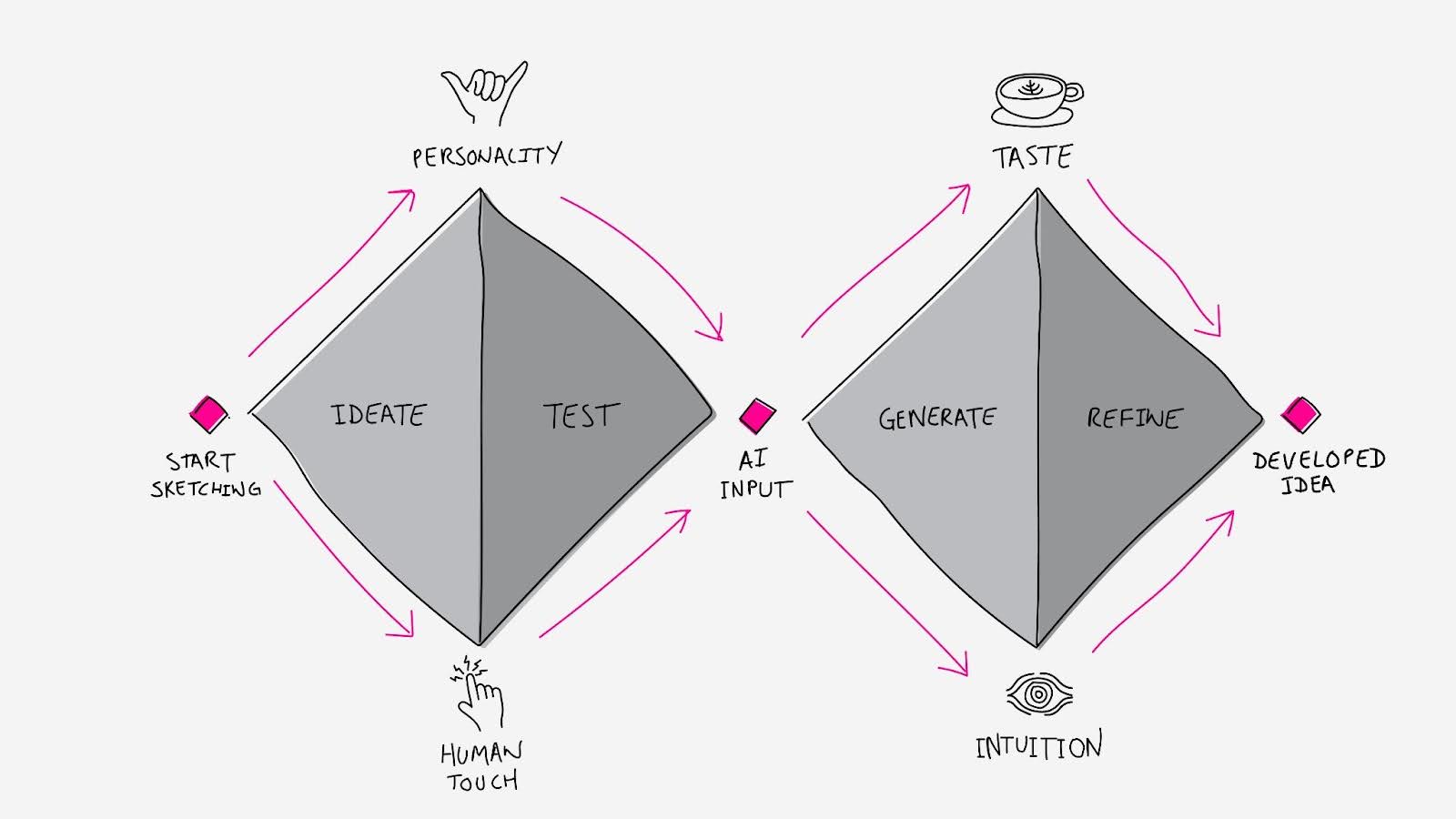
Have you tried Uizard or Relume? Maybe Stable Diffusion? What about some of the more well-known AI tools like ChatGPT or Midjourney? With a new AI tool emerging each week, they can be hard to keep on top of. However, there is something timeless that continues to be a vital part of our design process that is often overlooked: a doodle, a scribble, a drawing.
While digital tools offer efficiency and precision, there’s something uniquely powerful about putting pen to paper. But how does drawing fit into our constantly evolving toolkit? And how can we bolster new tools with this historic skill to supercharge our design process?
Amplified Creativity
Hand sketching and drawing have an unparalleled ability to amplify creativity and unlock new, innovative ideas. Since the drawing of a horse on the wall of a cave in Lascaux more than 10,000 years ago, humans have used drawing to communicate new ideas. By breaking the bounds of a grid or the typestack of a design system, sketching offers a free-flowing space where ideas can evolve rapidly and organically without constraint. With so much product design following best practices and looking more and more alike, sketching gives back the freedom to try something new and take risks. It’s only a drawing after all.
Research in cognitive psychology suggests that drawing stimulates new neural connections associated with creativity and increases grey matter in the brain. By translating abstract thoughts into scribbles, designers gain new perspectives and insights. Drawing allows for the rapid exploration of multiple design iterations, allowing for more experimentation and innovation. Testing these early allows us to waste less time in finding the right idea faster.
The act of drawing not only activates the parts of the brain that enable better aesthetic senses, but also helps create deeper connections between different parts of our brains. This cognitive enhancement allows designers to be more aware and understanding of a problem, while also leading to more intuitive and creative thoughts and solutions. Beyond its immediate impact on design, drawing can also help individuals at risk of cognitive decline, such as those with Alzheimer's disease.
Also at a time where remote and hybrid working are becoming the norm, drawing can also foster a sense of mindfulness and relaxation—much like the ancient art of