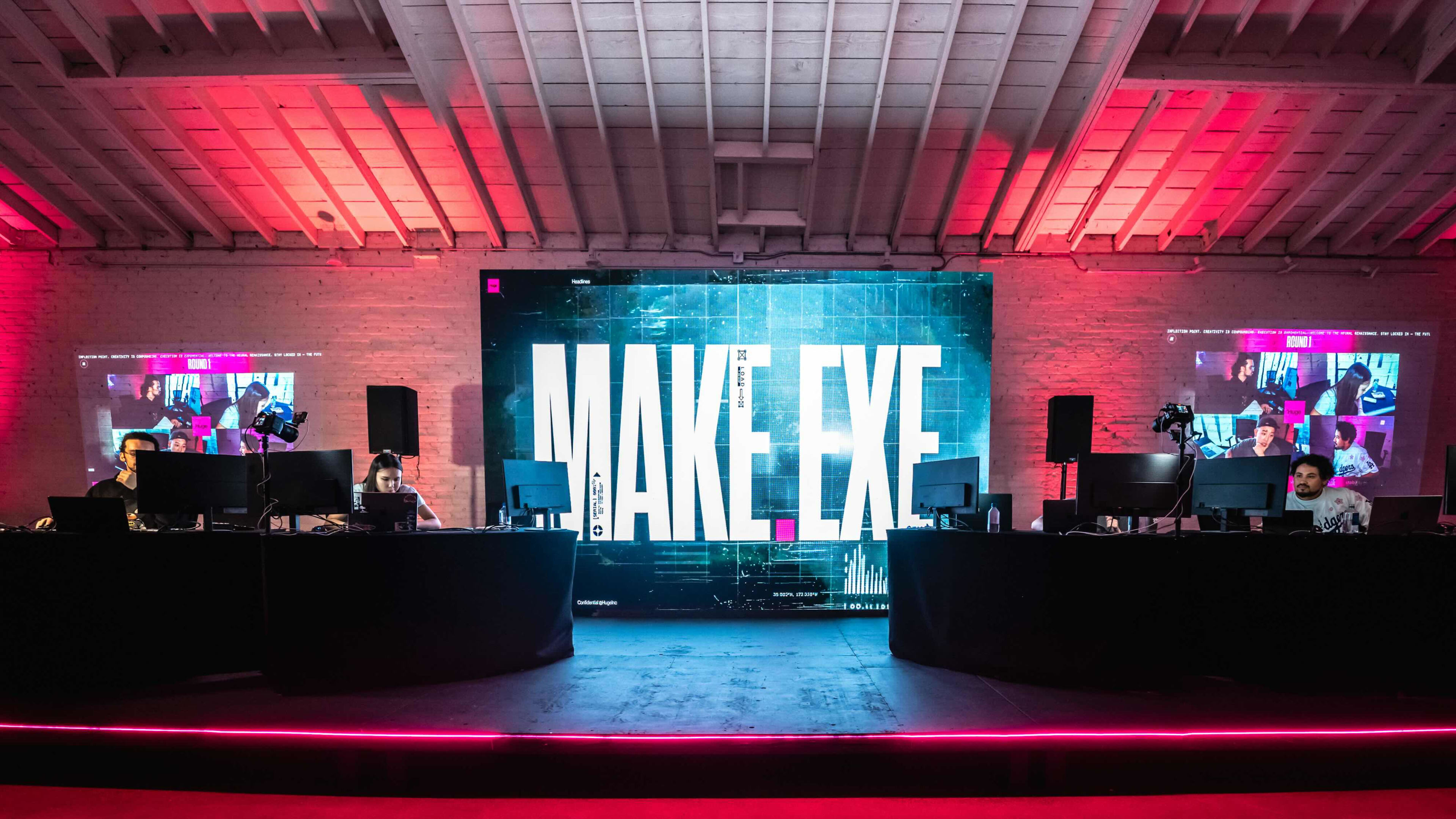
The setting.
We took over HNYPT in Downtown L.A. to create an immersive experience that celebrated creativity and digital design
AI is everywhere. Confidence isn’t.
AI adoption across the workforce rose 13% in 2025. In the same period, confidence in using it fell 18% (ManpowerGroup Global Talent Barometer, 2026). Among creative professionals specifically, 81% of designers say AI dulls creativity (University of Exeter DIGIT Lab, 2025), even as 94% report using it somewhere in their process.
The industry had a training problem. Everyone was running tutorials, workshops, and webinars. But passive learning was not building real confidence or changing creative culture. The gap was not access to AI tools. It was experience using them in real world work and on real clients, under pressure, and with purpose.
We asked a different question:
What if we stopped explaining AI, and let the making speak for itself?
Design entered its sports era. We built the arena.
Make.exe was born from a simple question HR posed to one of our lead designers: How can we teach AI? Can we demystify it, and make it fun and exciting?
The answer was not another curriculum. It was a competition.
We conceived, designed, and produced the first ever live GenAI creative battle, an esports style event where our designers and design students competed head to head, answering mystery client briefs using any AI or design tool at their disposal. What started as an internal AI enablement initiative became a culture platform the world could watch.
Same stage. Same briefs. Same clock.
Four designers from Huge and four students from Otis College of Art and Design took the stage at HNYPT in Downtown Los Angeles. In the first round, students and professionals competed individually. In subsequent rounds, they joined forces, pairing Huge creatives with Otis students to collaborate under pressure.
Across four battle rounds, competitors answered mystery briefs created by real clients: DirecTV and Behr. They were free to use any tool they wanted. Tools deployed during the event included Adobe After Effects, Adobe Illustrator, Adobe Premiere, Adobe Photoshop, ChatGPT, ElevenLabs, Figma, Gemini, Higgsfield, Jitter, Kling, KreaAI, Midjourney, Runway, Sora, Stability AI, and Veo.
The jury of industry leaders evaluated the work in real time. The panel included Huges Chief Creative Officer, Huges West Region Managing Director, a DirecTV Vice President, a Behr Vice President, and a leading creative design and technology influencer.
Captured like esports.
The event was produced with multicam coverage, live screen captures of each competitors work in progress, motion graphics overlays, stingers between rounds, and replay sequences. The result felt more like watching a League of Legends tournament than a design event.
The experience extended beyond the competition itself. An interactive tech sculpture served as the centerpiece of the venue, a physical manifestation of the evolution of creative technology, built in Unreal Engine and fabricated for the event.
Every element was designed, built, and produced by the Huge team, from the visual identity and Unreal Engine previsualization to the stage design, broadcast production, and sculpture fabrication.
AI as augmentation, not replacement.
Make.exe was designed around a core principle: AI is a creative tool, not a creative replacement. Human judgment, taste, and craft remained in control at every stage. Competitors chose their own tools, directed their own creative process, and made every decision about the final output.
The event was tool agnostic by design. There was no prescribed tech stack, no sponsored platform, no required workflow. The only rule was to ship, whatever it takes.
This approach reflected Huges broader position on AI in creative work: that the most powerful application of generative AI is in the hands of skilled creatives who know how to direct it, refine it, and push it further than the tool can go on its own.
By bringing together two generations of creatives, experienced professionals alongside emerging student talent, Make.exe also demonstrated that AI fluency is not a generational divide. It is a shared creative frontier.
Client ready creative. Made live.
In front of 300 people, eight competitors delivered world class design assets in real time. Across four rounds, they produced work responding to real client briefs, not hypothetical exercises, but challenges drawn from active brand needs.
The outputs ranged from brand campaigns and product visualizations to motion graphics and conceptual design systems. The quality of the work produced under extreme time constraints demonstrated that AI augmented creative workflows can deliver at the highest level.
From internal enablement to cultural platform.
Make.exe began as an answer to an HR question about AI training. It became something far larger: a proof of concept for a new format in creative culture.
The event demonstrated that AI confidence is built through doing, not watching. That the best way to demystify generative AI for creative teams is to put it on stage, under pressure, with real stakes. And that when you frame AI as a creative amplifier rather than a threat, people do not just adopt it, they perform with it.
Make.exe positioned Huge at the forefront of the conversation about AI and creativity. Not through thought leadership content, but through a live experiential proof point that showed the industry what AI augmented creative work actually looks like when it is happening in real time.
For the Otis College students, the event provided a platform to demonstrate their skills alongside industry professionals. For the Huge designers, it was a chance to push their craft in a format that demanded speed, instinct, and creative confidence. For the audience, it was evidence that the future of creative work is not something to fear, it is something to experience.
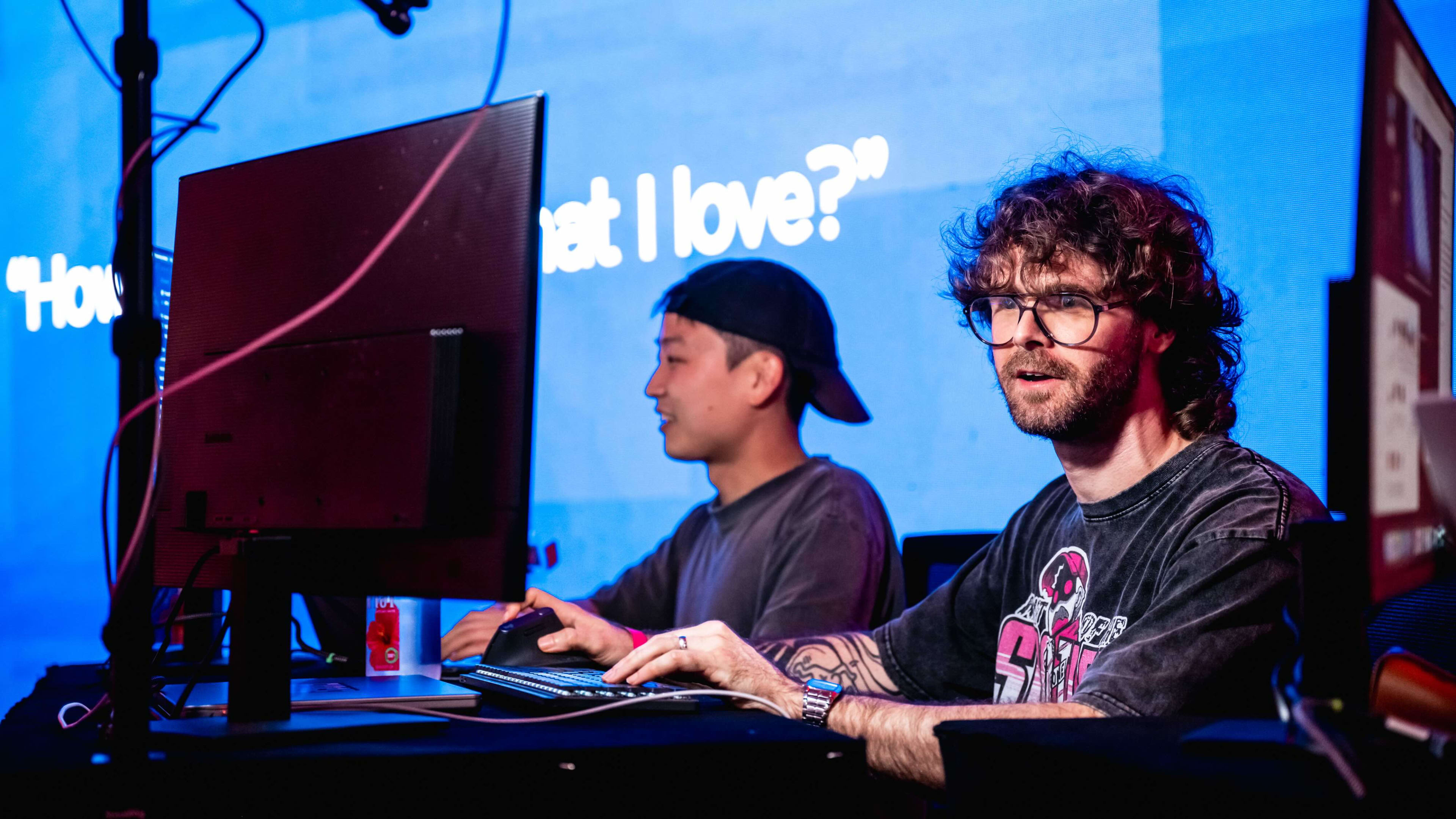


We took over HNYPT in Downtown L.A. to create an immersive experience that celebrated creativity and digital design


Our goal was not only to push the boundaries of what was possible with GenAI and emerging technologies, but also to bring new generations of creatives into it.
Huge designers and Otis students produced world-class design assets in front of clients in real time.