PPL
Culture & People
January 9, 2026.
Makers #5: Josh Campo and Lauren DeGeorge
Our newly appointed CEO and Chief Client Officer, Josh and Lauren bring a decade-plus-long business and creative partnership that has survived mergers, different titles and roles, and a few defining eras in the agency world. This is the dynamic duo’s story of navigating industry change as well as personal and professional transformation.
Interview by José Simián and Jessica Hall.
Photos by José Simián.
Change is inevitable, both in life and in business. But strong partnerships feed off it, something Josh Campo, Huge’s brand-new CEO, and Lauren DeGeorge, Huge’s recently named Chief Client Officer, know all too well. For more than a decade, these two leaders have grown businesses and led agencies to great success by challenging and listening to each other and—perhaps more importantly—facing change head-on with their shared philosophy centered on clients, talent, and optimism for the future.
Now it’s time for Josh and Lauren to bring their vision to life at Huge.
The Makers.
Josh: We first started working together at SapientNitro more than 12 years ago. I was Director of Technology and Lauren was Client Services Account Supervisor. Our paths crossed often because so much of the work was technology-driven. While I loved the technology side, I also was secretly working my way into client services. And then in came Lauren with all these crazy marketing, performance and creative ideas, and we ended up being client owners, working across the same portfolio of business.
Lauren: It was some of our happiest times working together. I was coming out of a creative agency, where I would work on super creative ideas that often never got developed or deployed. And then I went to [SapientNitro], which did almost no creative, but could deploy so much stuff. It was the first place where I saw the possibility of making ideas come to life.
The team was composed of all men—all former technologists or PMs. There were people who had worked on projects like replatforming the floor of the NASDAQ, while I had … done a content blog for Michael Kors! And they would say, “Oh, that’s nice.” But it was an amazing experience because, you know, I learned what a sandbox is. Or I learned about distributed delivery. Starting from day one, I’d be up late at night working with teams in India on things I had never worked on before—and doing it with people who knew how to do it all at scale.
Josh: I learned about a lot of things—about brands and about the importance of strategy and creative. I also learned how important creative is to bringing in people who have a better sense of the art behind an experience. Lauren would often tell me when things didn’t make sense.
Lauren: We also learned how to work across all the crafts combined! Back then, I didn’t know how to partner with technical PMs, for example. But Josh knew how to manage delivery folks, technologists, QA folks as well as manage people across different geographies. Then I came in and creatives and strategists were my besties. So we were able to bridge everyone’s perspectives in that way.
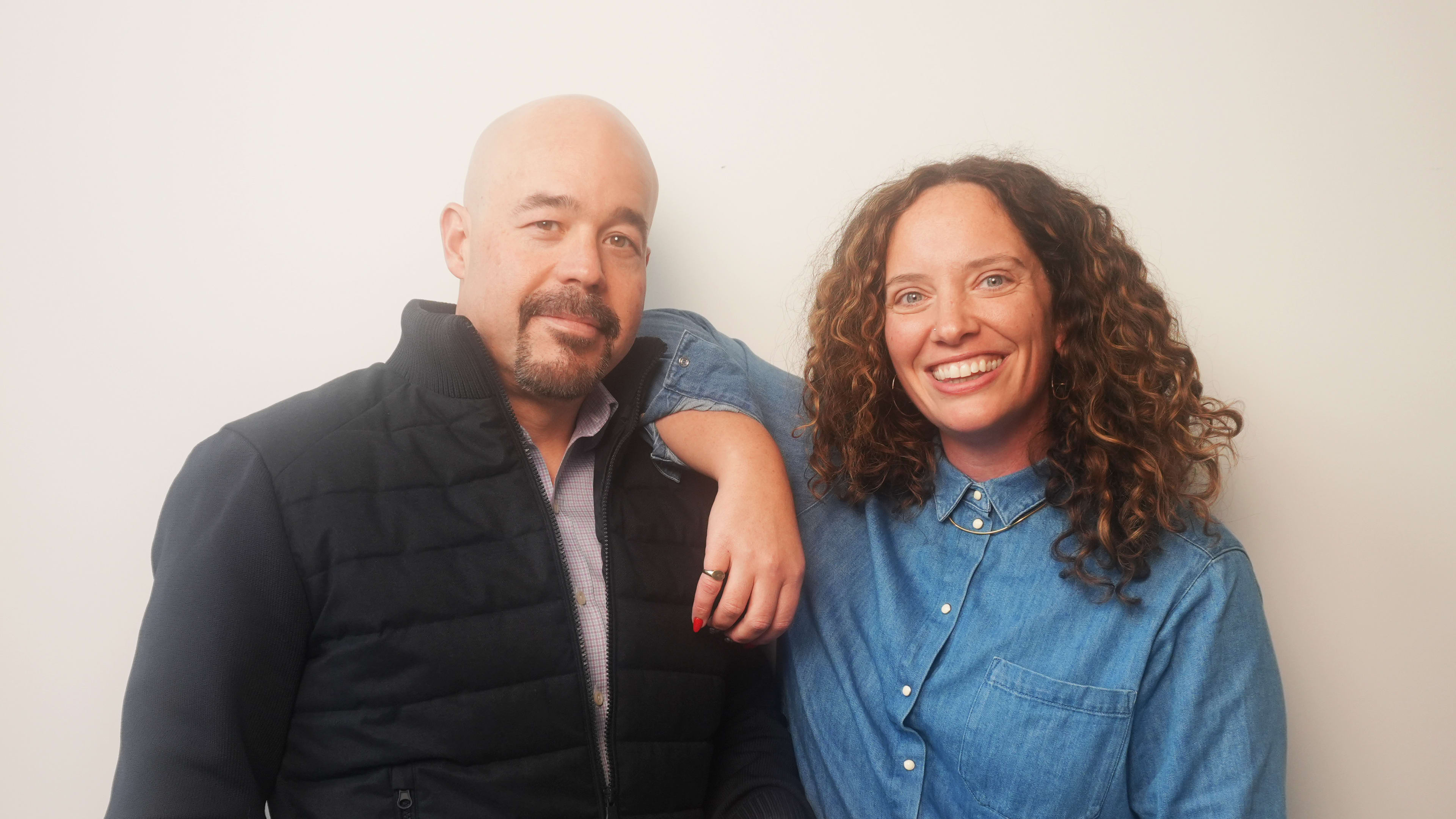
Josh and Lauren at the Huge headquarters.
The partnership.
Josh: Our collaboration wasn’t necessarily a linear progression. We both grew tremendously during our time at SapientNitro and the organization underwent significant changes while we were there. We had intersections of working together, but we also paralleled. I think there’s value in having a friend and a colleague who isn’t necessarily in your business, but who you can be advisers and confidants as you’re navigating the crazy world around you.
At some point, we both saw a shift in the agency business as it moved toward a more consulting space or management consulting space. We both saw the value in the work we were delivering for clients, which maybe wasn’t pure agency work but certainly wasn’t pure consulting work either. And because we liked what we were doing, we both recognized it was time to move on, and we ended up moving on to different places on the same day.
We both went into very different worlds. I moved into the traditional advertising world, and learned a lot about agency management, creative media, and the challenge of integrating technology into that line of business.
After about 12 months apart, we reunited at Publicis. Within that year, we both had tremendous growth in different ways, and being able to bring it back together was just such an elevation. That might be the previous milestone in navigating all the changes that occurred in that new world: developing a partnership with greater trust and knowledge by having two achievement-oriented people support each other’s individual growth along with the growth of the business.
Lauren: I think we also swam in the same pond, but in different circles. Josh came back talking about paid media, reach and frequency, and I said, “Who is this man?” But also, “Tell me more!” Meanwhile, I had done a stint in the digital arm of a large PR company, so I came back talking about earned and micro communities in social media.
Because of all of this, we built relationships side-by-side and our roles at Publicis were true partner roles. Josh was running an agency and I was working in a network role, which meant getting in everyone’s business and trying to make things better across agencies. Josh built strong relationships in his new world, and I built mine. Then we connected those worlds.
Josh: One of the biggest things we both learned over the past 12 years of partnership is that who you work with is every bit as important—if not more important—than where you work. And we’ve learned the value of relationships, not just from a client’s point of view, but from a team’s point of view as well. We understand how to enable teams to work together efficiently and intelligently: when do I pull Lauren in; when does she pull me in? I also think we’ve developed a certain shorthand with each other. That type of partnership is incredibly valuable when you think about speed, efficiency and trust.
Lauren: We both understand that in any service business, there will be emergencies and there will be mistakes. It’s inevitable. That’s why you can’t put a price tag on being able to look at your teammate and say, “I got you, we’re going to figure this out together.” Teams that understand each other make better work, and clients can tell. And we’ve always made it a priority to build high-trust teams.
Josh: When I look back on our partnership, there isn’t a single piece of work that I would point to as the epic one. What matters more is the dynamic of how we work together: Lauren knows better than anyone when to pull me into a discussion and, similarly, I know when it’s time to bring her in. A lot of times those are handoff moments that make the collective work better.
Lauren: Professionally, we have never outgrown each other as partners because we've never put each other in a box. Our relationship has tenure, layers and depth. I watched Josh become a CEO (but he was CEO before he was CEO!), and Josh watched me become Chief Client Officer. I think there’s also a lot of space for us to become different people in the whole relationship, and that has helped our clients succeed because we often knew what each other was capable of before the other one knew.
Josh: You’ll learn that Lauren is always more profound than me!
Lauren: That’s why I let you go first!
Why Huge?
Josh: One way of thinking about the future of our industry is the value of talent. When I met people from Huge (having known the brand from afar for many years), it was clear that great talent is what drives great work and real outcomes for clients. Large holding companies will promise scale, but scale can be a trap. It’s challenging at that size to authentically claim being centered on nurturing and enabling the highest level of talent, when it’s really only about scaling mediocrity.
As I thought about what I wanted next in my career, I was looking for a place where I could have an impact—for clients and for the industry—by investing in great talent. What I saw in Huge was the opportunity to resurface what our industry has always been about: using creativity and deep thinking to solve business problems.
Having the very best 900 or 1,000 people focused on doing that is a powerful thing. Five years down the road, that’s what will win; scaling mediocrity will not. That belief—and the chance to be part of an independent company—was a big reason I came to Huge.
Lauren: Huge loomed large in my head starting from my early days in advertising. I worked at an agency that specialized in hospitality and they sold cheap websites to get retained marketing contracts. So the opposite of what we do! And one year, every single one of my clients called me and said, “We need that Four Seasons website!” It was the most beautiful website on the Internet at the time and I thought, “What is Huge doing?”
For me, aside from the opportunity to reunite with Josh, there were a couple very concrete things I was looking for when I came to Huge. I didn’t want to go someplace that was media-led. (Media is incredibly important to our clients, but I didn’t want to be confined to a plan that was set in place in a different business context.) Being somewhere where we have the possibility of impacting the business with the work that we do is very important to me. I also wanted to go someplace where it didn’t feel like the ceiling was right above my head—and that’s less for me and more for our clients.
I think there is a sense at Huge that we can do anything (within reason). Everybody loves constraints and we know why we’re here—to make clients successful and to make our company successful—but there’s not really an asterisk there: the goal is success for everyone.
Being in a privately held company that’s built on two pillars—design and technology—creates a very clear box to live in with a lot of space to play.
Josh: Our new offerings are intentionally simpler, not because the work is simple but because clarity matters. We’re not trying to be everything to everyone, but we’re connecting what we do directly to clients’ outcomes. Clients are under enormous pressure—from boards, shareholders and executive teams—to deliver results. Increasingly they care less about how many hours something takes and more about the outcome. Being a partner who is genuinely invested in a shared outcome is essential.
Our independence affords us the freedom to invest in that kind of model, in ways large public companies simply can’t.
Navigating difficulties.
Josh: We were recently talking about the toughest moments in our relationship working together, and it’s interesting that I don’t think we’ve ever had a knock-down, drag-out fight. I think it’d be fun to see, in certain ways.
Lauren: We’re both really scrappy!
Josh: It would be a dirty fight, to be clear! But I think, ultimately, we have a lot of respect for each other’s roles. I think, depending on the context, we have a respect for who’s accountable for making the decision, and whatever the outcome may be from that.
I think there have been times in Lauren’s role where she’s come to me with something she wants to do and I’ve said, “Look, it’s your decision. Go for it.” I may not agree. I'll say why I don’t agree, but you have to be able to authentically own accountability. And I think there have been times I’ve had to make decisions where Lauren has voiced a perspective and I’ve made a different decision, and she’s shown great respect for the decision, and said, “I will only tell you ‘I told you so’ once I see it does not work out!” I think that level of respect is important and has enabled us to work very well together professionally, while also allowing us to have a friendship that has survived all matters of change and wildness that has occurred in the industry and within organizations.
Lauren: I agree with everything you said. I think there is such a trust between us and I think our values are very similar and generally aligned to doing the right thing. I know that can sound quite nebulous: the right thing can be different based on the day and based on the context. I’m not making ourselves to be moral superheroes, but I think generally our angle is: What’s the right thing for clients, company culture, talent, growth? Some combination of that is usually the thing we both want.
We’re both people who like to solicit a lot of inputs, and that’s actually good because we’re not myopically only talking to each other in this little echo chamber. We’re both very social people who are curious how other people react to things, particularly when there are decisions we haven’t made before.
Josh: She likes to say we’re both very social. I think Lauren is very social and projects that onto me, which I appreciate. But I think it’s true that we bring the opinions we hear from others into the discussion and decisions that are getting made. So that they’re not made in a vacuum.
And I would also say it’s important to note that when we talk about making what’s right, like you said, it’s not a moral judgment: it’s about what’s right in the context and in the moment. Hopefully, they are all also morally aligned and valid decisions. But this is a for-profit business. We have to achieve growth. Growth enables us to do the right thing even more often; it enables us to invest in our people the way we want to. And it enables us to do great work. I think we both have a fundamental understanding of that.