PPL
Culture & People
December 10, 2025.
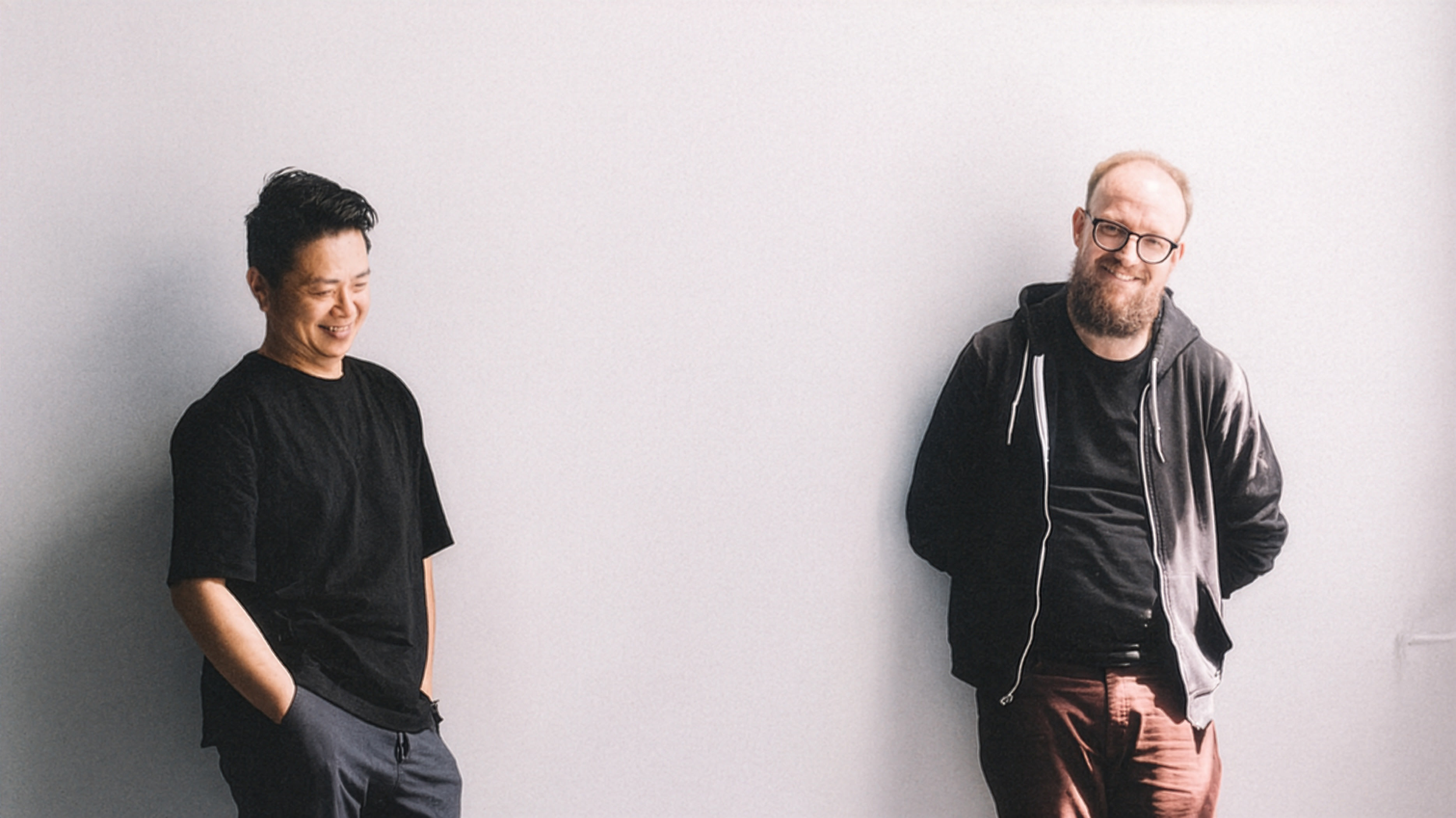
Makers #4: Ken Frederick and Michael Lin
A shared belief on pushing boundaries launched a two-decade partnership for these two creatives, and has helped them turn their natural tension between complexity and clarity into a formula for success.
Interview by Jessica Hall.
It's a cliché to say that opposites attract. But in the case of Ken Frederick and Michael Lin, it may well be true—and the interaction between their different styles may be fuel for the journey that recently brought them to Huge after the acquisition of their successful independent agency Both&Yes.
While they are both creative directors, each one brings a distinct "superpower" to the mix: Michael focuses on the narrative and clarity of the design, while Ken delivers motions, experimentation and code prototyping. Together, their collaboration leads to solutions neither could reach alone—with Michael being a “good foil” to Ken’s admitted “drive to add complexity.”
Their partnership —which began more than 15 years ago at Landor in San Francisco— has helped shape the visual identities and digital experiences of major brands like Google, YouTube and Waymo thanks to the duo’s quest for richer, more exciting ideas.
In this installment of Makers, Ken and Michael tell the story of that partnership, and what excites them most about their future at Huge.

Ken and Michael joined Huge in October, with the acquisition of Both&Yes.
The Makers.
Michael: We met many years ago at Landor, we were on different teams and didn't formally collaborate on any projects. But we got to know each other through mutual co-workers and, over time, we developed a real respect for each other's craft. When I got to check out some of the work that Ken did, I really appreciated his attack-forward explorations. I think that mutual respect eventually turned into a partnership.
Ken: Ha, Michael's so polite! I remember seeing work in the [Landor] office and asking, “Who did this?” And someone replied, “Oh, Michael did that.” And I was like, “Man, f*** that guy! — it’s so good!”
I remember he was working on the Logitech identity, and I absolutely loved it. It was so smart and considerate.
I’d see it around the office while I was working on my own identity project and think, “F*** this, I quit”. I just couldn’t compete! It was just so thoughtful, so good.
Michael: I always wanted someone to bounce ideas around with, someone who speaks the same language, understands my background, and can push things in a totally different direction. That's how we started Both&Yes. Ken and I come from similar roots, but our superpowers are different. I would say I'm more of a systems narrative person, while Ken gravitates more toward more motions, experimentation and code prototyping. It's that complementary energy that lets us mix our strengths and deliver something richer for our clients.
Ken: Michael is always a good foil to my inherent drive to add complexity. We’ve found a good balance in that push and pull of how we approach communication. I think we both appreciate that, at the end of the day, we're trying to solve problems – whether it's technical, business or brand. Ultimately, it gives us clarity in how we work.
YouTube was a great example of a project where Michael would start something. Then I’d take it further and eventually pass the ball back. It wasn't always intentional: sometimes it was just necessity, but it always felt fluid. Neither of us had any ego about it. I was never offended when I opened a file and saw that Michael had completely reworked what I’d done, because it was always for the better. Michael always entertained me when I would say, "Hey, I thought about this,” or “I built a little tool,” or “I just tried a quick motion experiment to bring something to life." Those are just small examples, but it illustrates his point: we play off of each other well. We understand what we're both good at and we respect it. It’s always, "All right. We can do this type of thing together.”
Michael: We look at the same problem and we both naturally approach it from different angles or perspectives. That tension allowed us to create more richness to the solutions that we're delivering.
Growing with Huge.
Michael: At Both&Yes, Ken and I were really fortunate to be able to take on a wide range of projects and we were able to collaborate directly with the clients. But, at the end of the day, we were still a relatively small operation and, oftentimes, we had to say “no” to some opportunities simply because we weren't able to scale. So, now we’re at Huge, we have the access to bigger teams, more and deeper capabilities and so that we were able to take on more complex challenges. That really excites me because we're able to build systems that can really scale, whether it's for brand, for product, motion or AI. So, we're able to go to the client with confidence and say, "Yes, we can do it."
Ken: Being part of an organization that's well known and respected – that aligns with our values and how we think about how creativity should work – feels like a fit. We both come from a design background, but our skills overlap in a way that Huge embodies. The best part of the whole process is the people and how everyone is just game for good ideas.
The unlock.
Ken: There's this seamless back-and-forth in how we work. Michael and the team will be building something and we’ll figure out how to activate it in a way that brings it to life. For example, Michael was drawing an ungodly amount of icons to help one of our clients figure out their new brand. I was tapped in more as a creative technologist. Michael would draw something and it was my job to build a tool to push it further, add animation, or explore how it could behave in different contexts. I got to play this experimental role and build all kinds of prototypes. I had a lot of fun, and it also really played to our strengths.
Michael: I totally agree with Ken. It was the perfect project for both of us because it allowed us to lean into our expertise. Although I’m not sure if I’d call it “rewarding” because I had nightmares about icons! But what made it great was that we weren’t just delivering static icons. Ken would explore how some of the icons might be dynamic across different products, creating personalized experiences within the product interface. Instead of me spending hours and days coming up with different variations and options, Ken would be able to kind of come in and say, “What about if we built this tool to demo our idea in a more sustainable, dynamic way?” And that’s what elevated the work.
Future thinking.
Ken: I think success for me is to think about: How do we chart these waters together? There's a Huge that was, and there's a Huge that can be. And we can be able to look back and say —in one year, three years, five years, ten years— that we were part of that transition; part of helping Huge rekindle its Huge-ness.
Michael: I would just kind of look at it from a more personal growth angle. I think it's really rare in your career to find a true peer that you know someone that is on the same level, who understands you, who can also challenge you, and also complement you. And I think success for us is to really try and continue to inspire each other every day. Be able to do great work and be able to build great teams together. I think that if we're able to kind of keep this duo, this chemistry alive, everything else will just follow.