
PPL
Makers #7: Emily Wengert and Jon Hackett
Emily and Jon may focus on different areas but, at the core, they’re two sides of the same coin, blending art and science to create something exceptional.
Interview and text by Jessica Strubel.
Photos by José Manuel Simián.
Ask Emily and Jon about OLI—NBCU’s AI-powered chat experience for the Paris and Milan Olympics—and you won’t just get a surface-level overview. Instead, they’ll provide a detailed account of the project’s evolution, from technical features, to the challenges of operating at massive scale and the realities of building responsibly in the age of AI.
Our Global Head of AI Strategy and VP of Technology, both long-tenured at Huge, reflect on the partnership behind the work; an alliance defined by trust, “civil candor” and the kind of productive tension that drives innovation forward.
In this installment of Makers, Emily Wengert and Jon Hackett reflect on two intense years of building OLI—and why creating something truly new takes far more than a 9-to-5.

Years in the making.
Emily: Jon and I are in enough meetings together that we often play off each other’s intros. I'll say all my parts and then he goes, “Yep, the same for me, just on the tech side.” The cool part about our maker partnership is that we’re both deeply in the innovation and emerging technology space, and we have been for a long time. I have been here for 17 years and in that time I’ve often been pushing the edges of what we offer and what we’re thinking about. I’ve always been interested in trying to be ready for what’s next. It’s why I love agency life. It’s the pressure our clients put on us. About 10 years ago, I started doing experiential physical-digital work and did a lot of AI. We worked with computer vision and machine learning. We did eye tracking. We had robotics, augmented reality, virtual reality—all the realities.
That’s where I’m stealing Jon’s intro, because he always says “all the realities.” We’ve both played in the acronym space, which is also one of Jon’s jokes. Now, we work so much together, I just steal his jokes and he has nothing to say.
Jon: We’re the same but different. We are offering up two sides of the same coin. It’s a good combination. It’s the art and the science coming together. I’ve been at Huge for almost five years, but I have 20 years of working in this industry. I started as a programmer when web technology was getting popular and, as the mediums evolved, I always chased whatever was new or unknown. When a new technology came out, I was the one of the early people to dive in, break it down and understand the best way to approach it.
Then AI has kind of eaten into our lives lately and all of my focus. And that’s my not-so-short background in a nutshell.
Jon and Emily at the Huge headquarters in Manhattan.
Solving real-life problems for OLI.
Emily: What’s especially great about OLI is that it began with a reach out from the CMO of Sports and Entertainment at NBCU, trying to figure out if generative AI might help her with a problem during the Summer Olympics: there’s 7,000 hours of programming and people have trouble finding exactly what they want. It was genuinely exciting for us at Huge to get that ask, especially at a time when a lot of people were applying generative AI to the wrong problems. But she was asking the right question and OLI is what emerged from that.
When we began creating it, we didn’t know what it would become. We thought it would be a chat experience and a way to present programming information. We named it, branded it, designed the entire interface—UX and UI—and did the front-end development. We ran data investigations to figure out how to power it. We vetted technical partnerships and we landed on Google as being a great partner to help establish it. The Olympics have such a bright spotlight, and we needed big guns to make sure that this could launch successfully and handle the traffic. For the Paris Olympics, OLI was live on five websites, guiding users directly to the programming they were looking for—even deep-linking you to Peacock at the exact place streaming began. It automatically tailored schedules to your time zone. Audiences could ask OLI unexpected questions. The most common one for Paris was, “When is Simone Biles on?” But we were really pleased that we’d figured out how to handle “unspecified queries.” Someone could ask, “What should I watch tomorrow afternoon” or “What should I watch this weekend?” and it could actually think about that and respond meaningfully.
That’s tricky work because it isn’t just extracting the keywords and building an answer. It had to understand the business rules, the logic and any specific guidelines in the message. After Paris, the business was excited enough that we expanded what we’d built for the Milan Cortina Winter Olympics this year. This time it was on 19 different websites. We added extra features: athlete bios, video, multimodal capabilities and medal count cards with sponsorship. We also made the conversation smarter. So, after the first question, it offered “next best actions”—three recommendations for what to request next, making it relevant to what was previously asked.

Emily speaking at the launch event for OLI during the Milano Cortina Olympic Winter Games.
Navigating the unknown.
Jon: The first version of OLI was about building something we weren’t exactly sure how to do, but we were confident we could do it. There’s something exciting about traveling through the unknown, breaking a problem apart and rebuilding it piece by piece to get to the other side. That work is exciting when you’re forging a new path without having the answers up front.
We built a proof of concept wired directly to NBCU’s data to show it would work as intended. It brought together parts of their business that don’t typically need to collaborate but, from a consumer standpoint, the experience across all channels had to feel seamlessly integrated.
The Olympics is a massive event, and the sheer volume of traffic in such a short period of time has its own unique set of technical challenges. At that scale, directing hundreds of millions of people into a single experience can very easily cause things to break. That was a big concern, which is why we pulled in Google early given their known ability to rapidly scale.
We also wanted our clients to feel safe about the known hallucination risks. At the time, there were many stark stories about AI going wrong. Our team did a lot of complex—mind-bending or tedious—work to make sure it was safe; figuring out the logic to prevent significant incidents while knowing that this technology can’t be completely controlled. We also spent time thinking about brand voice and how we could convey it consistently.
Emily: We realized that OLI needed to take on different voices or roles. There’s the friendly welcome voice, where it sets expectations for what it can do. There’s the voice of fandom, which was important to us; it had to carry the energy and excitement of a real Olympics fan. And then there’s the confident coach. We leaned into a lot of sports analogies. On the coaching side, if a user asked something that was out of bounds, how does OLI gently bring them back? The coach couldn’t be sycophantic, just agreeing with everything. We recognized that people play different roles and tones in their own life and OLI needed to do the same. It became a multifaceted brand voice.
Jon: We did a pretty good job on the first run. The second run for the Winter Olympics was exhilarating in a different way. We had confidence from Paris and clear ideas on how to improve and expand the experience. We became smarter about how we leveraged newer AI techniques in development and testing, leaning into evaluation frameworks and automation as a core focus. That shift helped us to scale more effectively while maintaining quality in a much more disciplined way.
The unseen hours.
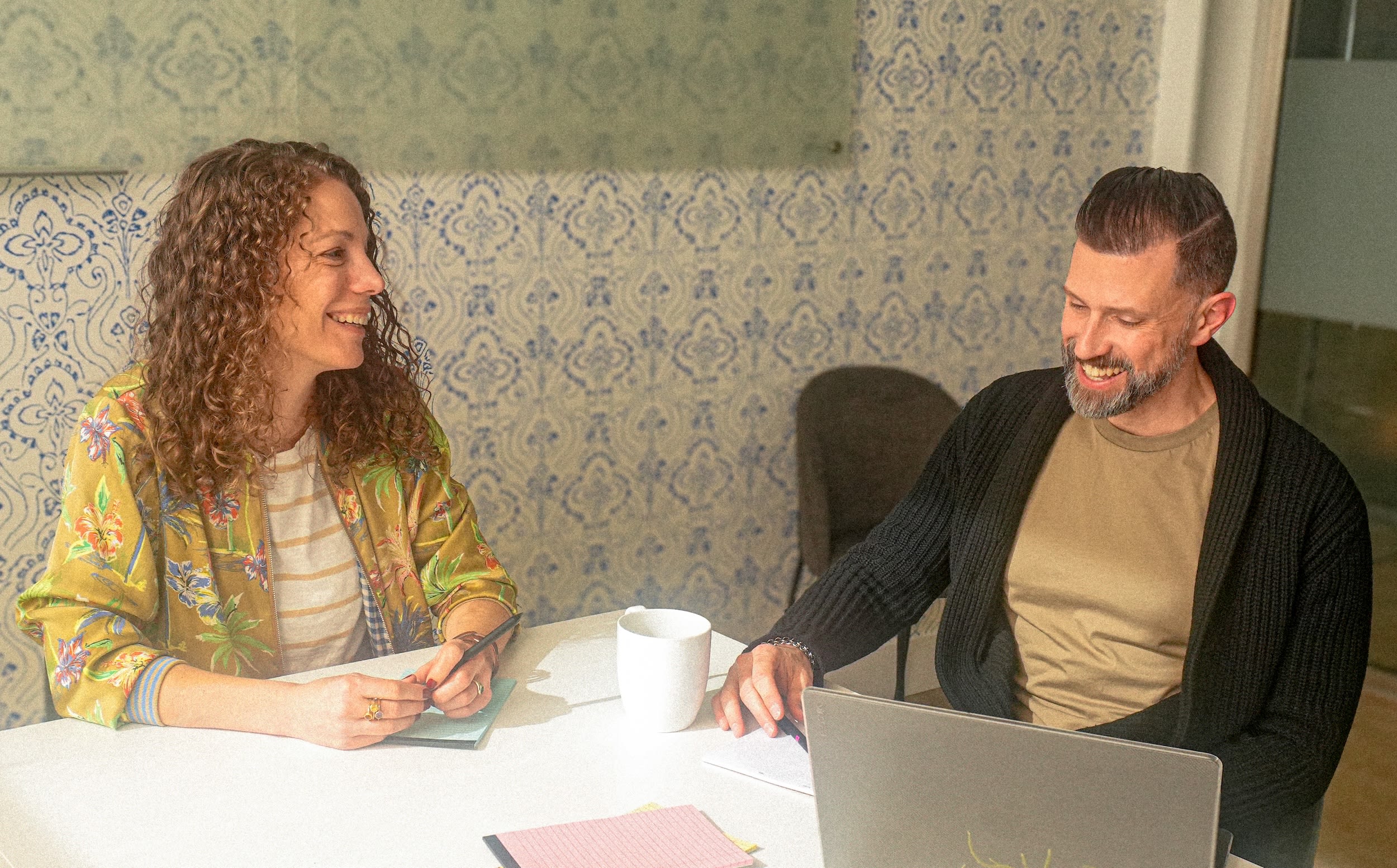
Emily: Is this the appropriate moment to bring up trauma bonding? When you’re doing hard things and making them real, you spend a lot of time together. You go through moments where you’re sweating it.
Even though our end success has been very clear, we’ve also broken things along the way. What builds trust is going through that stress together and coming out the other side. We had moments where one of us was stressed and the other wasn’t, so we balanced each other out. But when we were both stressed, we learned to raise the alarm.
That’s a big part of innovating together: the ability to survive the hard moments. A bad mood isn’t a long-term story. You figure it out, you talk it through. I’ve always felt that I can be completely honest with Jon. There’s no topic we can’t unpack.
Jon: We have a high level of candor and a lot of safety around that. We’re direct. We don’t mince words. But it’s always in service of the work. When there’s tension or disagreement, it’s because we both care about getting the best outcome. That tension can be uncomfortable, but it pushes the work—and us—forward. I think that’s a very productive cycle.