
The Tiered Content Framework
CS
Strategy.
June 4, 2026.
Content Strategy as Structural Infrastructure
An approach to apply the same compositional logic that Atomic Design gave to UI components to semantic content objects.
By Jedi Wright, Senior Content Strategist.
Image generated by Sara Jaye.
Introduction.
Design systems changed how we build interfaces.
The concept took shape in the early 2010s as engineering and design teams at large organizations, such as Google, IBM, Salesforce, and Airbnb, started asking a common question: why does every new product have to reinvent the same buttons, headers, forms, and navigation patterns from scratch? The answer was to stop treating UI elements as one-off decisions and start treating them as a governed, reusable library. A design system defines the components of an interface: their visual properties, their behavior, their approved usage, and makes them available across teams. Build the button once. Govern it once. Use it everywhere.
The Atomic Design methodology, introduced by Brad Frost in 2013, gave that approach a principled structure. Frost argued that interfaces could be decomposed into a hierarchy of reusable parts: atoms (a single UI element like a label or an input field), molecules (small groups of atoms that function together), organisms (larger interface sections composed of molecules), templates (page-level arrangements) and pages (the final rendered instances). The framework gave design and engineering teams a shared vocabulary and a compositional logic that made UI components governable at scale. It became one of the defining moves of the modern digital product era.
But there’s a gap no one fully accounted for: the content living inside those components remained ungoverned.
In practice, this gap looks like this: a product team carefully governs their card component, the container, the image dimensions, the type styles or the spacing, but the headline that goes inside it gets written differently by every author who touches it. One team writes it as a noun phrase, while another writes it as a sentence; a third uses it to surface a promotional message it was never designed to hold. The component is consistent. The content inside it, isn’t. Multiply that across hundreds of components, dozens of authors and several years of CMS drift, and you get experiences that look coherent at the interface layer and fragment at every layer beneath it.
Voice and tone guides tell you how the content should sound. Editorial checklists tell you when it’s ready to publish. But neither instrument addresses how content should be structured, modeled, related to other content, governed at the field level or reused across an enterprise digital ecosystem. The result is a predictable failure mode: experiences that look coherent at the interface layer and fragment everywhere else. Inconsistent messaging. CMS architectures are built on drift and duplication. Authoring workflows that depend on individual expertise rather than shared system logic. And every replatform, every personalization initiative, every channel expansion that grinds to a halt at the content layer.
The Tiered Content Framework that I devised applies the same compositional logic that Atomic Design gave to UI components to semantic content objects instead. Where Frost mapped atoms, molecules, organisms, templates and pages (a hierarchy of visual and interactive elements), the TCF maps a parallel structure: Quarks, Particles, Clusters, Zones, Structures, Ecosystems and Biomes. The governing unit is not the interface component but the content object: its meaning, its structure, its relationships, and the governance rules that make it reusable across systems. It is a direct extension of Atomic Design methodology into the content strategy domain—the same bottom-up composability, applied to the layer Frost's model never addressed.
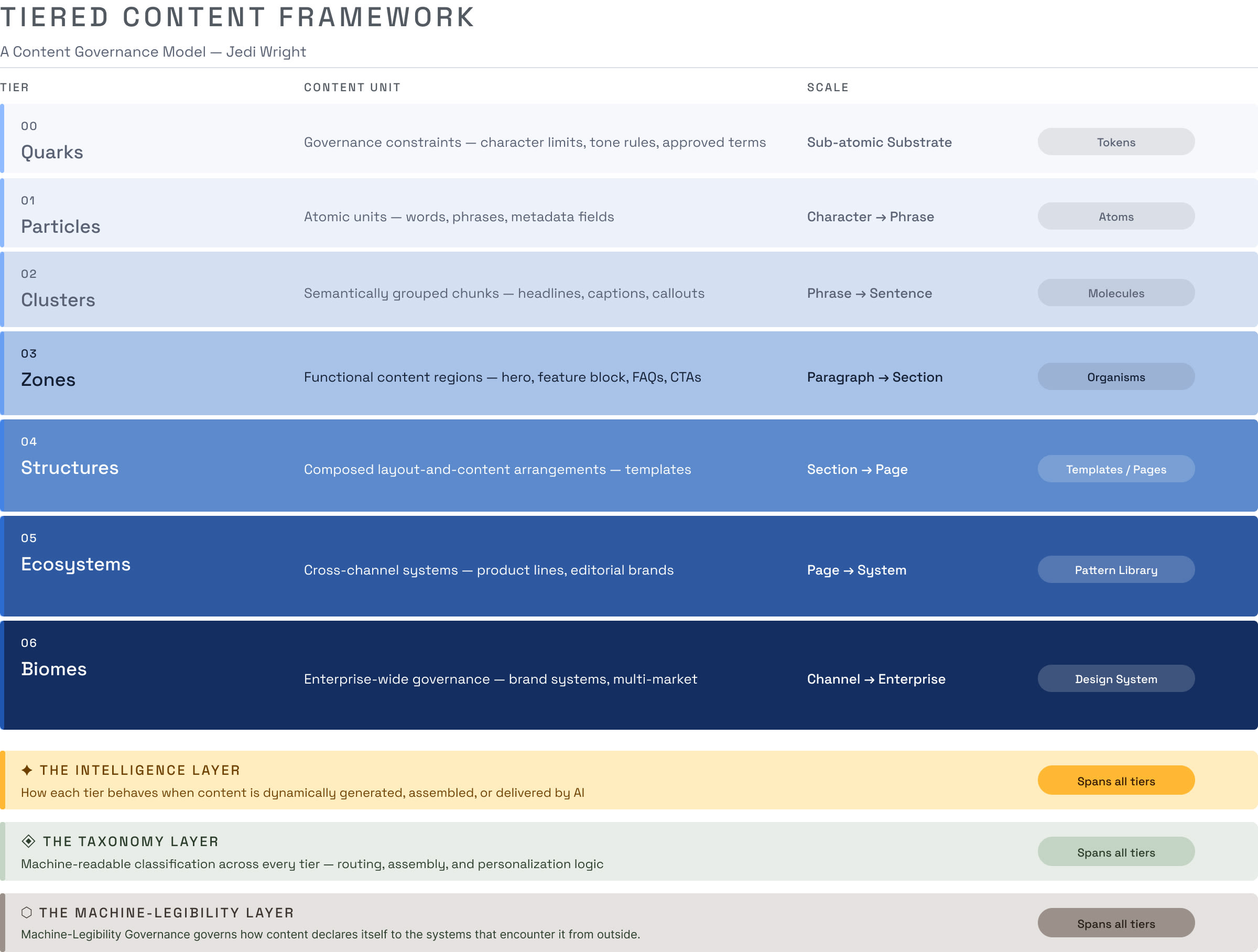
The seven tiers.
The Tiered Content Framework defines a seven-tier hierarchy (Tier 0 through Tier 6) that scales from the governance constraints beneath a single content field up to an entire enterprise digital presence. Because every tier builds from the one beneath it, a governance decision made at the field level propagates automatically through every component, page and channel built from it, rather than having to be re-enforced at each level by hand.
The practical benefit is that content quality, consistency and reuse become architectural properties of the system rather than editorial disciplines that depend on individual authors getting it right. A CTA label governed at the Particle tier remains consistent whether it appears in a web component, a mobile push notification or an AI-generated response. Not because someone checked but because the structure doesn’t allow drift.
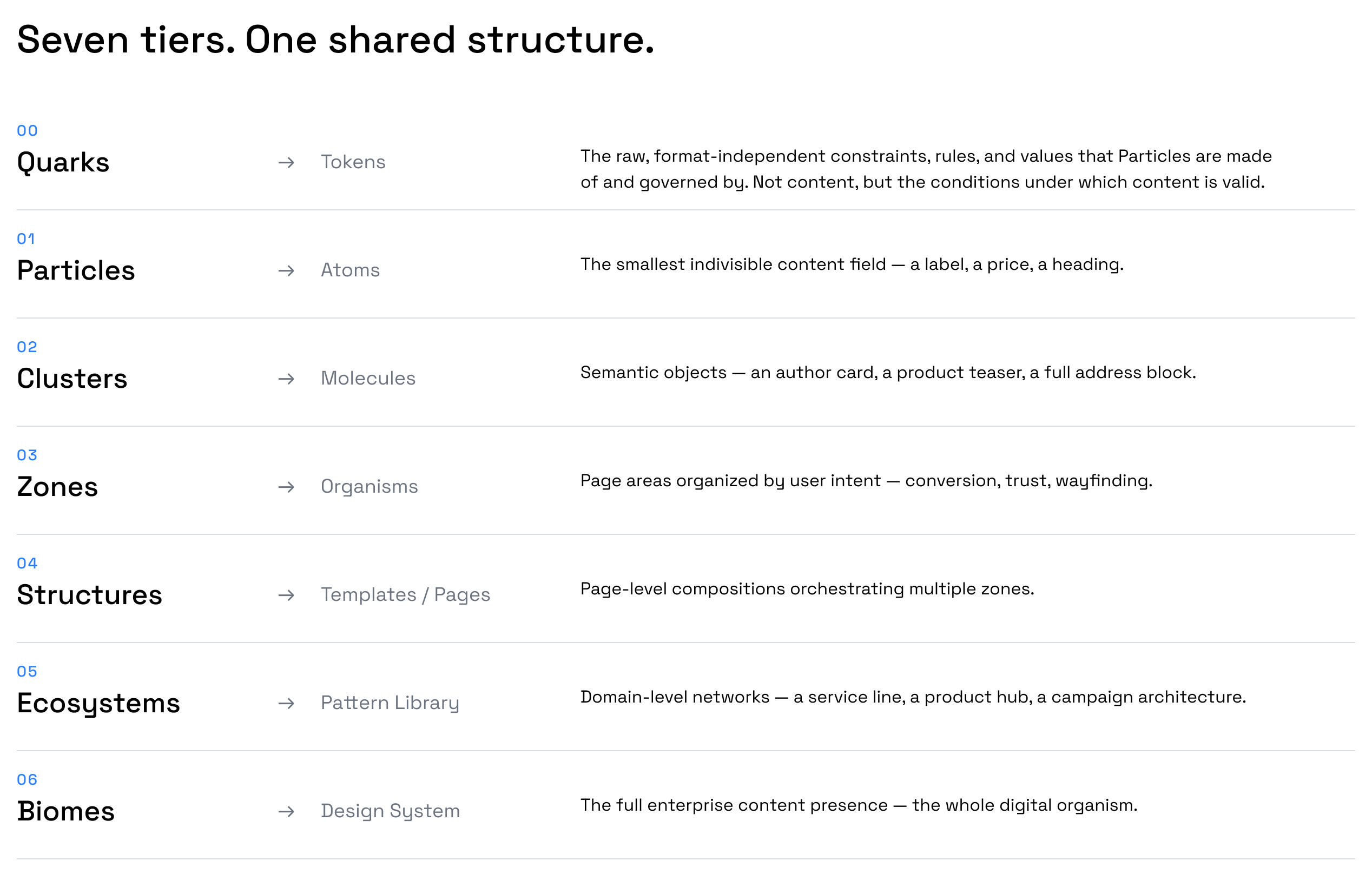
What the seven tiers mean.
Quarks are the sub-atomic layer: the raw, format-independent constraints, rules and values that Particles are made of and governed by. They are not content. They are the conditions under which content is considered valid: approved terminology lists, character limits, tone parameters, taxonomy values, metadata schema definitions, accessibility thresholds, brand voice primitives, and prompt-engineering constraints governing AI-generated content.
A concrete example: a healthcare system rules that patient-facing content must never use “provider”; instead, it must use “doctor,” “nurse,” or a specific role title. That rule is a Quark. It governs every Particle that renders a staff reference: the name field on a physician profile, the attribution line on a patient education article, the suggested response in a symptom-checker tool. Change that Quark because, say, the organization rebrands around a broader care network, and every downstream field and surface that inherited it updates automatically. No hunting through 4,000 pages!
Quarks are the highest-scrutiny tier in the governance model for exactly this reason. Every modification propagates downstream through every Particle, Cluster, Zone, Structure, Ecosystem, and Biome that inherits from it. The stakes of that governance decision become clearer when you see what happens in its absence.
In a recent engagement with a healthcare system, a content and IA team inherited a site with many site pages built over more than a decade. Terminology had accumulated the way it always does, without structural governance: set by clinical operations, reinforced by departmental habit, and never reconciled against how patients actually searched or spoke. “Neurosciences” appeared as a primary navigation label. “Rheumatology” had no plain-language equivalent anywhere in the information architecture. Condition names, service titles and specialty references varied across navigation, page copy and physician profiles—not because anyone made a bad decision, but because no decision had ever been made at the right tier. Everyone was working from the local convention. No one was working from a governed source.
The replatform forced the question. During taxonomy and IA work, the team had to make explicit, on the record, what had previously been implicit: for every patient-facing clinical label, what is the governed term, where does it live, and what inherits it? The determination that “brain health” was the patient-entry point, the term patients used, the term that served findability, while “neurosciences” belonged to the clinical and SEO register, was not a copywriting call. It was a Quark-level governance decision. Once made, it propagated: the navigation label, the page headline, the meta description, the specialty field on physician profiles and the structured data markup all resolved from the same source. The rule was set once. The content followed.
Without that governance tier, the replatform would have done what most replatforms do: migrate the drift. The new CMS would have inherited the same unresolved terminology, now encoded into a fresh content model and distributed across a new information architecture. The next team to encounter it would face the same reckoning—except with less institutional memory and more surface area to reconcile.
Particles are the smallest indivisible content unit: a single field with a single job. A headline string. A CTA label. A price value. A street number. Particles are typed, validated and reusable across systems. Govern a Particle well, and everything built from it inherits that quality. This is the atomic data layer: the foundation for personalization, automation and omnichannel delivery.
Clusters are logical groupings of Particles forming meaningful semantic objects. An author card. A product teaser. A full address block. A Cluster exists because those Particles belong together, and the combination means something a single field doesn’t. Clusters are portable, reusable content objects that bridge data modeling and UX design. They are the primary unit of CMS modularization.
Zones are context containers: functional regions within a Structure that govern content assembly for a specific purpose. A Trust Zone. A Conversion Zone. A Wayfinding Zone. Zones introduce strategy into the structural model—they define not merely what content is present, but why it is present and which user-journey moment it is designed to serve. Zone logic applies across surfaces: web pages, app screens, AI assistant responses, digital displays.
Structures are endpoint compositions: the complete, governed assembly of Zones delivered to a specific surface. A web page. An app screen. A voice response. An AI assistant answers. A digital billboard. Structures govern template strategy, zone sequencing, and IA alignment across the design system.
Ecosystems are cohesive networks of interconnected Structures unified around a domain, brand area, or user journey. A hospital’s oncology service line. A software product's help center. A brand campaign architecture. The parts that belong together, governed together.
Biomes are everything: the complete digital content presence of an organization across every channel and surface it maintains. Multiple Ecosystems governed by shared strategy, standards and brand architecture.
Why this matters for how we work.
The practical value of the framework isn’t the naming; it’s the shared structural vocabulary it creates across disciplines that typically operate with different mental models.
When a content or UX strategist defines a Zone, a UI designer understands which Clusters are required. When a CMS architect models a Cluster, an engineer understands the Particle definitions that underpin it. When a product director governs a Structure, a content strategist understands how zone sequencing maps to user journey intent.
This translation layer matters. Without it, structural decisions, what content belongs on a page, in what sequence, organized around what intent, get resolved through ad hoc negotiation. Every project. With it, those decisions become governed reference. Change impact becomes traceable. A proposed alteration maps to its tier, and its downstream effects surface before implementation.
The authoring experience also changes. When the CMS is modeled around Clusters rather than bespoke page-specific fields, authors encounter reusable content objects with clear semantic definitions. When Zones surface as organizing principles within templates, authors understand not just where to place content but what user intent that placement is meant to serve. Governance moves from documentation to the system itself, and the right choice becomes the easy choice.
The framework also changes the production sequence. Because content is modeled as structured infrastructure—typed, tiered and governed—it becomes auditable before it becomes briefable. Gaps in the existing inventory surface at the tier level: which Clusters are missing, which Structures are underperforming, and which Zones have no governed content behind them. That audit becomes the brief. Edit-disposition content already in the inventory becomes the reference draft. New content is commissioned only after the existing inventory has been evaluated—not to fill gaps that the strategy invented, but to fill gaps the structure revealed. For teams managing large content ecosystems, that shift in sequence is as consequential as the framework itself.
Semantic and strategic governance.
Since the initial publication of this content strategy framework in April 2026, practitioner feedback has driven three cross-cutting governance dimensions that weren’t present in version one.
They run across all tiers, each addressing a distinct aspect of how the tier structure operates in dynamic, AI-mediated environments.

The Intelligence Layer governs how each tier behaves when content is no longer static output but active, responsive and machine-generated.

Taxonomy is the attribute layer that makes the tier structure machine-actionable. Classification is governed at the Quark level and declared at the Particle level. Quarks define which taxonomy values are valid; Particles carry them.

Machine-Legibility addresses how content declares itself to the systems that encounter it from outside: search engines, knowledge graphs, AI retrieval systems, and large language models. Every content object exists in two registers simultaneously—a human-readable presentation and a machine-readable declaration.
The principle that holds it together.
Design systems govern the visual and interactive layer. Content frameworks govern the semantic and strategic layer: meaning, structure, governance and scalability.
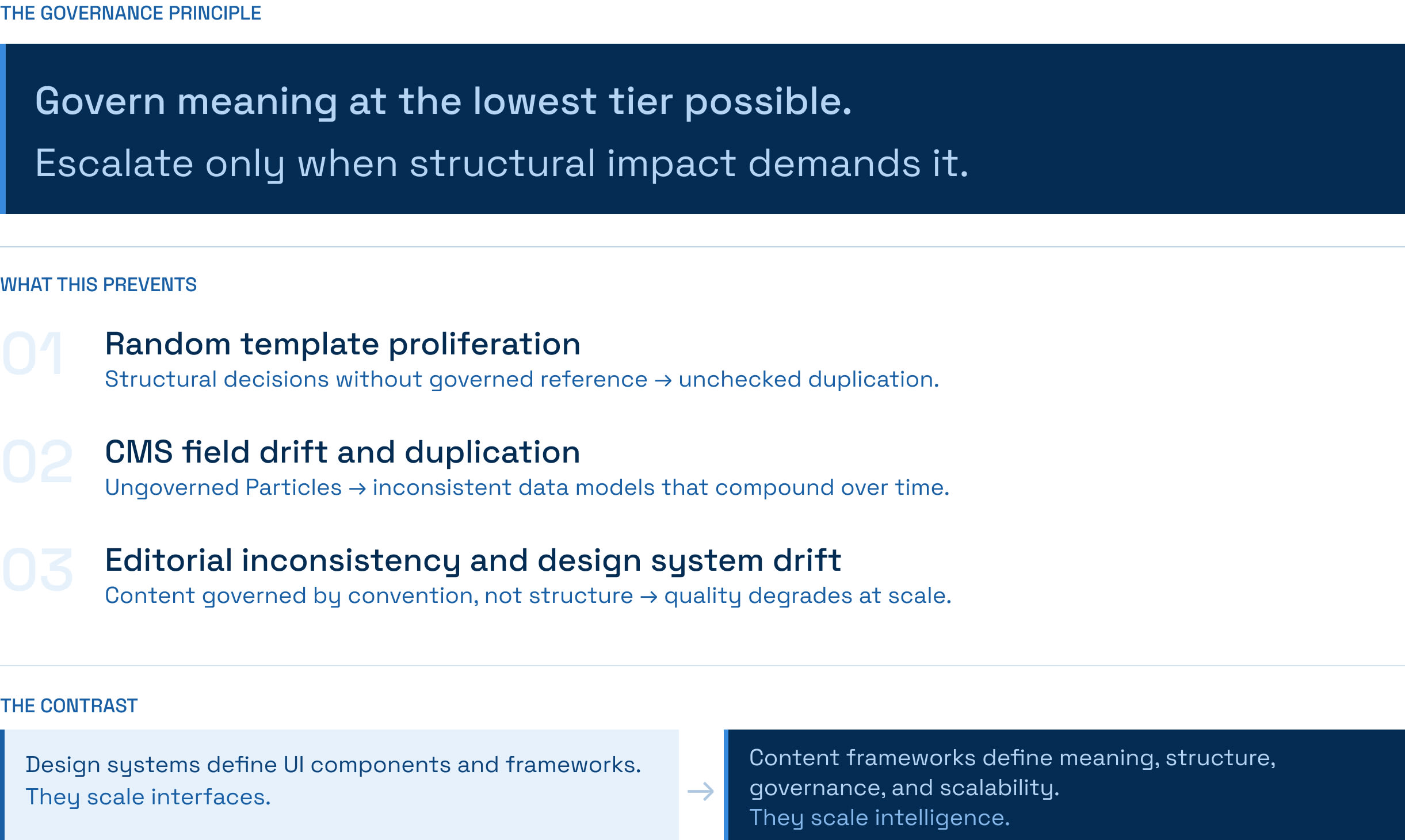
The Tiered Content Framework’s core governance principle—govern meaning at the lowest tier possible; escalate only when structural impact demands it—makes enterprise adoption feasible. It prevents the common failure modes: random template proliferation, duplicate content models, CMS sprawl, editorial inconsistency, and design system drift.
It also positions content where it belongs: not as editorial output, but as governed digital infrastructure. The difference matters. Infrastructure is built with intention, maintained with discipline, and measured against performance. Editorial output is produced to meet a deadline and is forgotten when the next one arrives.
In the broader architecture, the TCF operates as the governance layer of the Seam Stack—the framework layer responsible for how meaning is structured, classified, and made machine-legible before content travels across systems, boundaries, and parties. That positioning is deliberate: content governance doesn't end at publication. It extends through every system that encounters, retrieves, or re-presents the content afterward.
The framework is being pressure-tested in the wild and evolving accordingly. The question it was built to answer remains the right one: if design systems can govern interfaces with structural precision, why should content governance still depend on guidelines and convention?
It shouldn’t. And now it doesn’t have to.
* The full Tiered Content Framework is published here.