
MKT
Video Games
January 27, 2026.
The New Video Game Marketing Playbook
In a market characterized by an oversaturation of new titles, sluggish post-pandemic growth, and escalating production costs, adapting to today’s landscape will be critical for new titles to break through.
By Hiroki Murakami, Senior Director of Strategy.
Hero image by Lauren Chepiga using Midjourney.
Earlier in 2025, our team started talking about a new game called R.E.P.O. Hilarious, chaotic, and soundbite-worthy, clips of the game trended on platforms like TikTok and YouTube. Popular streamers began playing the new game, introducing it to millions of new players.
And it has yet to be released. R.E.P.O remains in early access under development by a small studio. At its peak, R.E.P.O commanded a concurrent player count of 270,000 players on Steam (for comparison, Battlefield 6 had 140,000 last weekend). Eight months later, the player count spiked again to just under 200,000 concurrent players following a new update.
R.E.P.O. represents just one of many potent examples of how the player purchase journey has fundamentally shifted in the era of digital distribution, social discovery and creator-led gaming culture.
The challenge is that the video gaming industry remains stubbornly attached to a marketing playbook built in a different era. In a market characterized by an oversaturation of new titles, sluggish post-pandemic growth, and escalating production costs, adapting to today’s landscape will be critical for new titles to break through.
The old playbook.
The legacy games marketing playbook is predicated on physical scarcity that no longer exists, namely the distribution of physical copies through physical retail. Those limitations shaped a playbook that is characterized by:
A fixation on release date. Campaigns take a singular focus on and typically conclude soon after the game is released, leaving it all on the field. This evokes memories of players lined up the night before release day at GameStop but is at odds with today’s always-on digital distribution and social discovery.
One-directional communications. Campaigns take a one-dimensional approach, carefully gatekeeping the release of new information, and often struggling to understand how to effectively engage players and creators in the process.
Traditionalist asset mix. While marketers from other industries have since shifted from long-form video to more hybrid and digitally-native assets, the gaming industry is still predominantly reliant on costly video game trailers.
The emerging landscape.
In contrast to this legacy playbook, a dynamic and vibrant gaming ecosystem has since emerged resulting in a fundamentally different purchase journey for players:
Post-launch success. As my colleague Ryan Welling has written about, with the rise of “the patient buyer” and digital distribution, discovery and sales are much more long-tail after launch than the legacy playbook would suggest.
Discovery driven by social platforms. Today, more players discover new games through their social media feeds (TikTok, YouTube and Twitch) than traditional advertising or storefronts often via content produced by creators. And this discovery often explodes post-release as creators are unleashed to scour new games for content.
Creator-led communities. Perhaps the most defining characteristic of today’s ecosystem is the gameplay-as-entertainment produced by creators. To describe how popular this content has become, consider that Mr. Beast’s dedicated gaming channel on YouTube has more subscribers than IGN, The New York Times, Xbox, and PlayStation, combined.
The new video game marketing playbook.
Creating a new playbook does not require finding new inroads. In fact, the stunning success of breakout titles from Balatro to Clair Obscur: Expedition 33 already demonstrate how to adapt to the emerging landscape.
We’ve utilized our proprietary AI platform Live to compare the campaigns of five breakthrough titles who benefited from the emerging landscape versus a baseline of five AAA titles who reflect the more traditional games marketing playbook:
Breakout titles:
Baldur's Gate 3
Black Myth: Wukong
Clair Obscur: Expedition 33
Hades II
Helldivers 2
Baseline titles:
Assassin's Creed Shadows
Doom: The Dark Ages
Final Fantasy VII Rebirth
Indiana Jones and the Great Circle
Star Wars Outlaws
Using this data, we can begin to illustrate three core principles that create the foundations for a new video game marketing playbook.
Principle 1: Marketing ends at launch → Marketing is decoupled from launch.
When analyzing the volume of online conversations, breakout titles outperformed the traditional “one and done” marketing investment at launch. They saw on average a 152% higher sustained volume post-launch compared to the baseline of AAA titles.
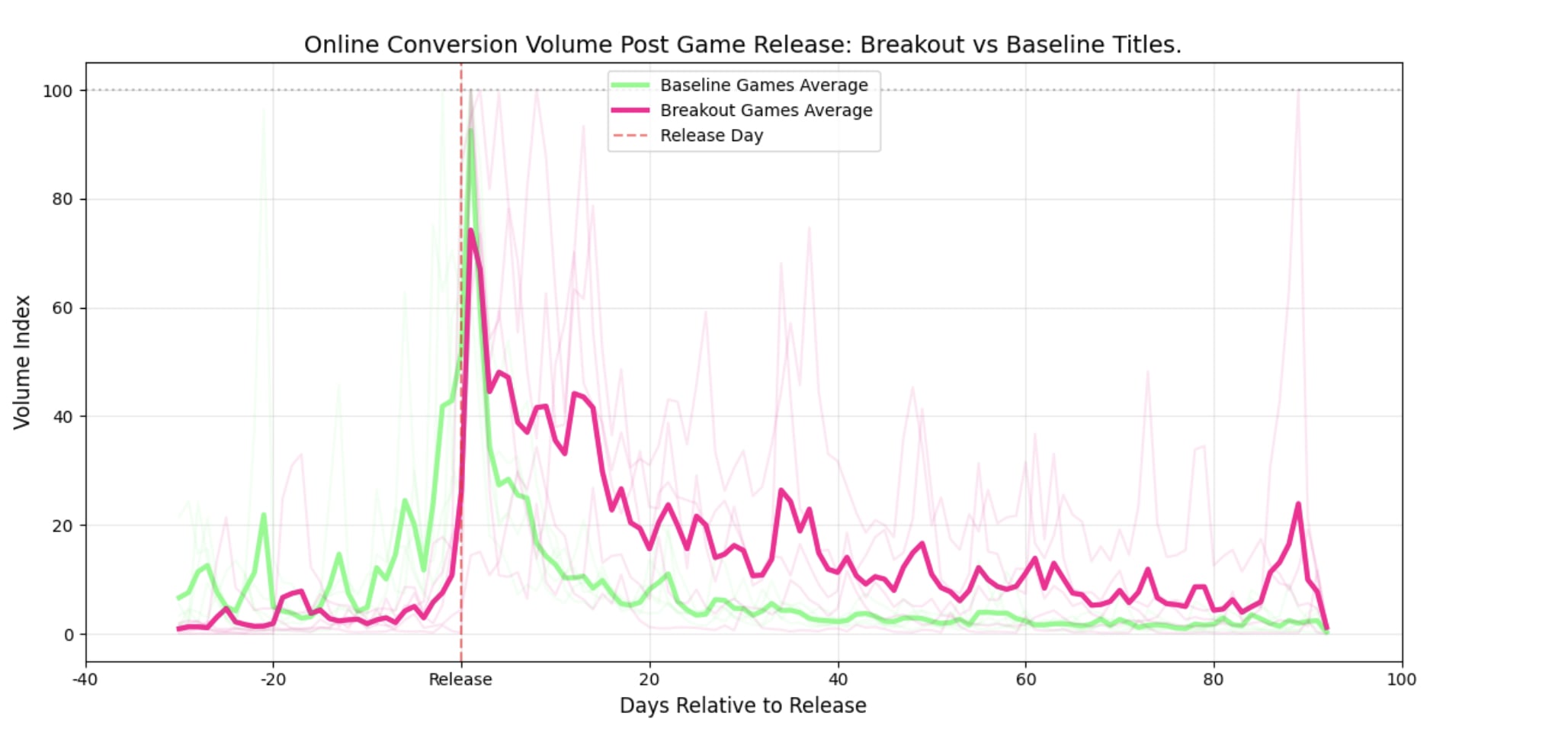
For example, Balatro grew and made most of its marketing investments post-launch. Such as an “unhinged” trailer that was inspired by a popular joke about the game. They waited until they had a critical mass of players and awareness before playing their hand.
Marketers should shift resources to capitalize on their post-release engagement and scale it. Furthermore, more fundamental shifts in how to go-to-market such as early access, or even the episodic releases of Dispatch, are worth serious examination by large AAA studios.
Principle 2: Marketing scales awareness → Marketing scales community (which scales awareness).
Huge analyzed YouTube videos about each game and used Google’s Vertex AI to categorize the videos into content that was created either by the game’s official channels or by their community. Breakthrough titles saw nearly x2 more total YouTube views on average than the baseline because of content created by their community.

Consider how Baldur’s Gate 3 found their most successful marketing moment after launch by bringing the voice acting cast to play D&D on creator Youtube channels. The videos generated more views and engagement than all of their pre-release trailers combined.
Marketers need to view creators as more than paid media distribution and instead rightly view them as the primary gatekeepers of the gaming community. This requires a more ongoing relationship. Beginning an organic creator strategy and outreach program should be a day one priority for every marketer. New models such as enlisting creators to advise during the development process and later evangelize the game are also worthy of consideration.
Principle 3: Marketing is one-directional → Marketing is participatory.
For many titles, there is often a marketing narrative as presented by the studio and another as voiced by the community. Successful marketers will accept that the voice of the community is infinitely more active, resourceful, and creative and find positive ways to direct their energy. Both Charlie xcx’s Brat and the movie Barbie saw the potential to be a wide canvas for participation.
This requires a more collaborative process. In the grim darkness of the Warhammer 40,000 fantasy franchise is a legion of creators dedicated to exploring its considerably expansive lore. As Warhammer 40,000: Darktide was nearing launch, Luetin09, a creator, was given exclusive access to the studio to reveal the universe of the new game in an hour-long video. The result? Nearly x4 more video views than their launch trailer.
Conclusion.
Above all else, adapting to the new playbook will require marketers to increase their depth of understanding of gaming communities. Traditional measurement tools can struggle to keep pace with the speed of gaming culture.
At Huge, this is why we’ve put our AI platform LIVE at the forefront of our work and leverage new AI-enabled capabilities to close the gap.
A new playbook for video game marketing is already being written by new breakout titles who understand the emerging gaming landscape. The greatest risk is posed to large legacy studios and publishers who have yet to embrace this new normal.